Do Wind Chimes Scare Birds? The Honest Answer
Contents[hide]
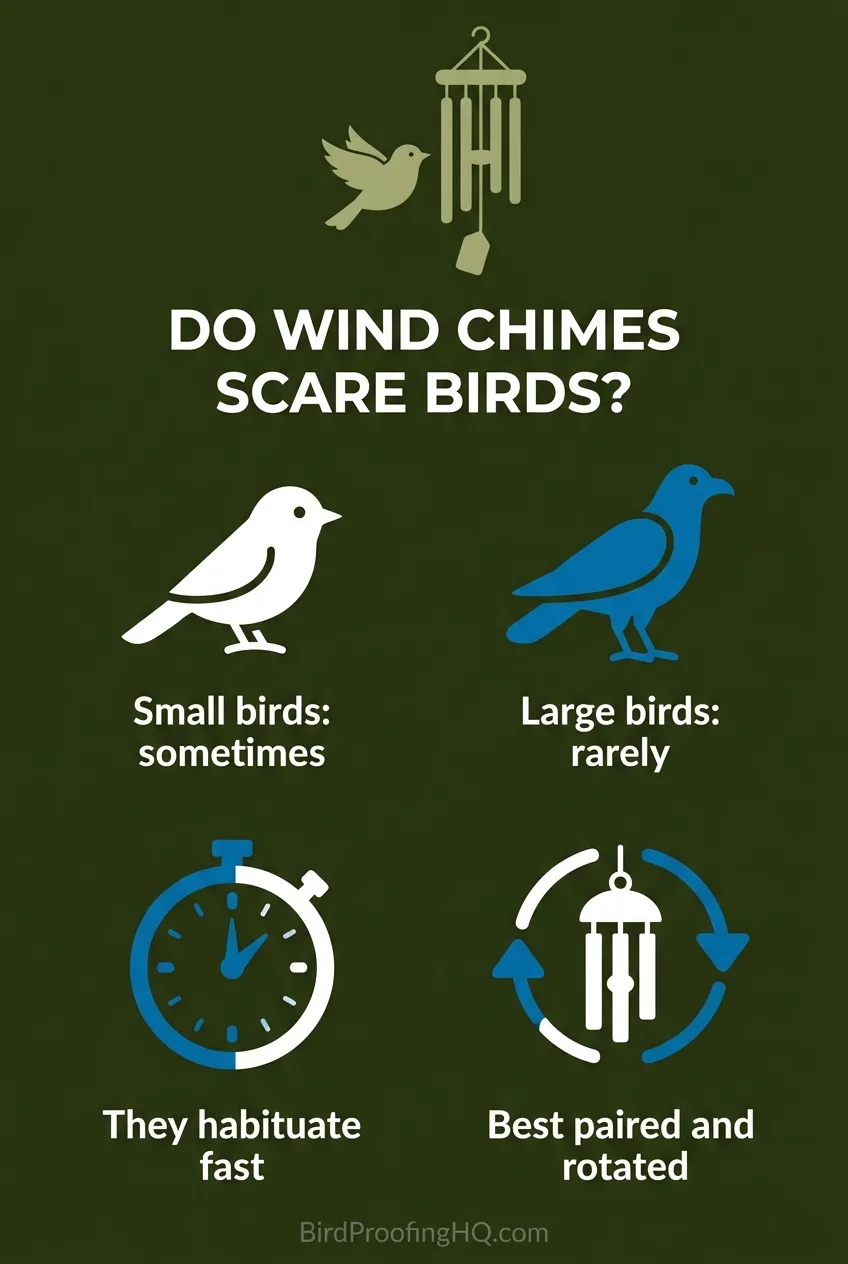
Wind chimes scare birds for days to a few weeks, then most birds habituate and stop responding. Moving the chimes every few days slows that process. Metallic chimes with a reflective finish work best, combining sound and flashing light. For any persistent problem, treat them as one part of a rotating deterrent strategy, not a standalone fix.
In this article, we’ll cover when wind chimes actually scare birds, how fast they stop working, and what to add so they don’t become background noise.

Do Wind Chimes Scare Birds?
Yes. Wind chimes scare birds by producing sudden, unpredictable sounds when the wind moves them. Birds interpret unexpected noise as a potential threat and avoid the area. The effect is real, particularly in the first few days after hanging them.
The key word is unpredictable. Birds are not afraid of consistent sound. Traffic noise, background music, or a fan running constantly does not deter birds. What makes wind chimes work is that they are intermittent and irregular.
A bird cannot predict when the next sound will come, so it stays cautious.
The same logic explains why wind chimes lose effect over time. Once a bird sees that the chimes never bring real danger, it stops treating the sound as a warning. Most birds reach that point within two to four weeks.
Why Birds Habituate to Wind Chimes
Habituation is the process by which an animal stops responding to a stimulus after repeated exposure without consequences. For birds, wind chimes are a textbook case.
A bird hears the chimes, hesitates, stays away. It waits, and nothing happens. It tries again, still nothing. Within days, nuisance birds that were initially deterred begin to treat the chimes as background noise.
Pigeons roosting on a ledge, sparrows at a feeder, crows raiding a garden, all of them habituate to static deterrents on a similar timeline.
This is not a flaw in wind chimes alone. The same goes for fake owls, reflective tape, and scare balloons. Any deterrent that stays in one spot without changing stops working. To stay effective, it has to keep birds guessing.
Movement and novelty slow habituation. A completely static deterrent stops working faster than one that changes position, angle, or intensity.
Using Wind Chimes Effectively
If you use them at all, do it like this.
Which Wind Chimes Work Best
Not all wind chimes are equally effective as bird deterrents. The material and design both matter.
Metallic wind chimes are the best option for bird deterrence. Aluminum or steel chimes catch light as they move and produce a sharp, unpredictable sound. The combination of noise and flashing visual movement creates a stronger deterrent effect than sound alone. Birds have to process two types of stimulation, which takes longer to habituate to.
Loud, randomly tuned chimes outperform musical chimes with a fixed, pleasant sound. A harmonically tuned wind chime that sounds like a pleasant song is less startling than a set of irregular lengths that clang unpredictably. For bird deterrence, annoying your neighbors slightly is a feature, not a bug.
Ceramic or wooden chimes produce softer, duller sounds with no reflective component. They are less effective as bird deterrents. Fine as decorations; not reliable for keeping birds away from feeders or a deck.
Long tube chimes that rattle at lower frequencies may help against larger birds, which respond differently to sound than small birds. Smaller birds like sparrows are startled by high-frequency clangs. Larger birds like pigeons and crows may respond better to deeper, resonant sounds.
Small Birds vs. Larger Birds
The short answer is that wind chimes work better on small birds than on larger birds, and the effect fades faster with larger birds.
Small birds are more easily startled by sudden noise. A sparrow at a feeder will flush quickly at a sharp clang. The problem is that small birds also habituate quickly, because their daily food-gathering routine requires them to take risks constantly. A sparrow that avoids feeders near wind chimes may simply move to a different feeder nearby.
Larger birds like pigeons and crows are more stubborn. Pigeons roosting on a ledge are food-motivated and territory-habituated. They may initially avoid an area with wind chimes but return within days.
Crows are intelligent enough to actively investigate new objects in their territory and reach a non-threat conclusion faster than most birds. Wind chimes are rarely sufficient to deter pigeons or crows on their own.
For nuisance birds of any size, wind chimes are most useful at initial discouragement rather than as a long-term solution.
Making Them More Effective
You can extend the deterrent effect significantly by treating wind chimes as part of a system rather than a standalone fix.
Move them every three to five days. Changing the position prevents birds from habituating to a fixed point. A chime in a new location is a new stimulus. This single step extends effectiveness more than any other change.
Combine with reflective objects. Hang strips of reflective tape or old CDs near the chimes. The visual flash reinforces the auditory effect. Birds are more likely to stay away from an area that produces both unpredictable noise and unpredictable light movement.
The combination keeps birds away significantly longer than either deterrent alone.
Place them where birds actually land or feed. A wind chime hung decoratively on one side of a patio while birds eat at a feeder on the other side does almost nothing. Hang them directly in or above the problem area, over feeders you want to protect, at the entry point of a deck or garden bed, or near a specific ledge.
Use more than one. Multiple chimes in different places create a larger deterred area and more randomness in the timing of sounds. Birds trying to find a quiet feeding window have fewer opportunities.
Shiny Objects, Fake Owls, and Wind Chimes: How They Compare
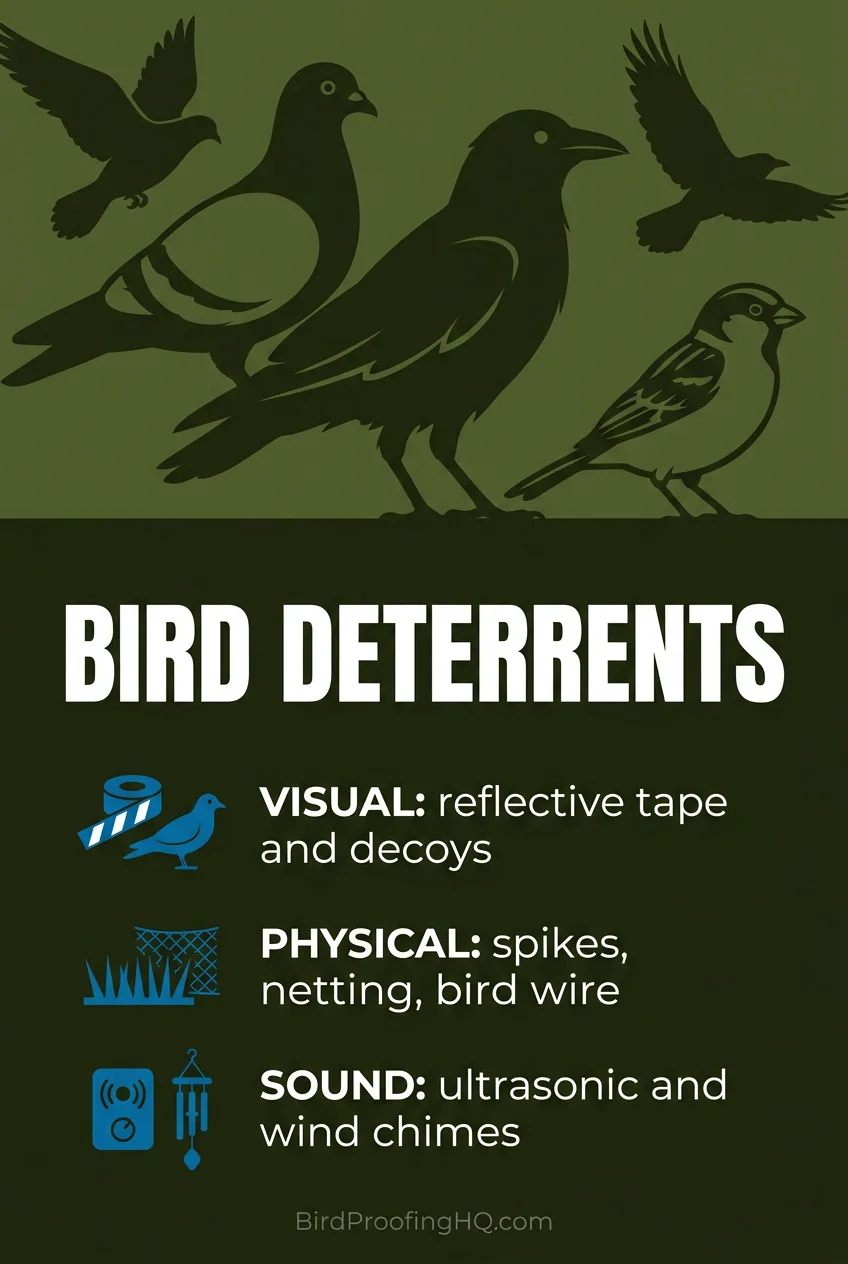
Wind chimes, fake owls, and shiny objects are all auditory or visual scare tactics. They work on the same habituation timeline. None of them is dramatically more effective than the others as a long-term solution.
Fake owls initially deter birds that have a strong predator-avoidance instinct, including small songbirds. Crows and pigeons investigate and dismiss them within days. Rotating a fake owl’s position every few days helps, as does a decoy that moves (such as one mounted on a spinner). Static plastic owls left in one spot stop working within a week for most species.
Shiny objects like reflective tape, old CDs, and aluminium foil strips work through visual disruption rather than sound. In windy conditions, they are effective. On still days, they do nothing.
Their advantage over wind chimes is that they cover a larger visual area. A strip of reflective tape along a fence top is birds afraid to land anywhere along that fence. A wind chime is a point source of deterrence.
Wind chimes have the advantage of working on calm days when there is still some breeze, and they combine sound with movement. Their disadvantage is that they require wind to activate.
The practical conclusion: combine all three, rotate their positions, and accept that no visual or auditory deterrent keeps birds away permanently.
When to Use Bird Netting and Bird Spikes Instead
For serious or persistent bird problems, wind chimes are not enough. Two physical barriers birds cannot get used to work far better over the long term.
Bird netting physically excludes birds from a specific area. A net over a garden bed, fruit tree, or pond prevents access entirely. Birds do not habituate to netting because netting does not rely on startling them. It simply blocks entry.
For high-value areas like berry patches or koi ponds, netting is the only method that holds up through an entire season without requiring rotation or maintenance.
Bird spikes prevent landing on ledges, fence tops, sills, and rooflines. A ledge fitted with spikes stays bird-free indefinitely because there is nowhere for birds to put their feet. Spikes are effective on larger birds like pigeons, seagulls, and corvids that are not reliably deterred by sound alone.
Use wind chimes for:
- Early discouragement before birds establish a routine
- Decks and outdoor areas where netting or spikes are not practical
- Supplementing physical exclusion as one element of a broader strategy
Use netting or spikes for:
- Garden crops and fruit trees with active bird pressure
- Building ledges and roosting surfaces
- Any problem that has persisted for more than a few weeks despite auditory deterrents
The Bottom Line on Wind Chimes as a Bird Deterrent
Wind chimes are a legitimate bird deterrent with one significant limitation: they stop working when birds stop being afraid of them. That happens faster than most people expect.
Move them often, pair them with shiny objects, and put them in the problem spot, not off to the side. Used that way, wind chimes are a low-cost way to keep birds away from an area for weeks at a time.
For persistent nuisance birds, treat wind chimes as a first line of defense while you set up something more durable. The bird deterrents guide covers the full range of options for every situation, from simple yard birds to birds on buildings.
Images: Wind chimes 1 by Kim Dae Jeung, CC0, via Wikimedia Commons.

Free: The 5-Step Bird-Proofing Checklist
Work through the right steps in the right order, before spending money on the wrong deterrents. Printable PDF, straight to your inbox.
No spam. Unsubscribe any time.