Do Bird Spikes Work for Small Birds? Risks, Limits, and Alternatives
Contents[hide]
- 1. Why Spike Spacing Decides the Outcome
- 2. Check the Ledge Before You Buy Anything
- 3. Which Small Birds You’re Actually Dealing With
- 4. Confirm There’s No Active Nest First
- 5. When Generic Spikes Can Still Help
- 6. Where Spikes Fall Short for Small Birds
- 7. Humane Alternatives That Handle Small Birds Better
- 8. When the Job Needs a Professional
Quick Answer
Rarely on their own. Standard bird spikes are spaced for pigeon-sized bodies, so many small birds, including house sparrows, can still land between the tines or nest on top of a mismatched row.
In this article, you'll learn whether spikes work on your small-bird problem. We'll cover spike fit limits, ledge inspection steps, and humane alternatives.
Why Spike Spacing Decides the Outcome
A bird spike strip works on one mechanism: it removes the flat, stable surface a bird needs before it can settle in for any length of time, whether that’s a quick rest or a full nest. That mechanism depends entirely on the bird’s size relative to the tines. A pigeon or a gull cannot fold itself into a narrow gap between rows, so a properly spaced, full-coverage row genuinely takes the ledge away from them.
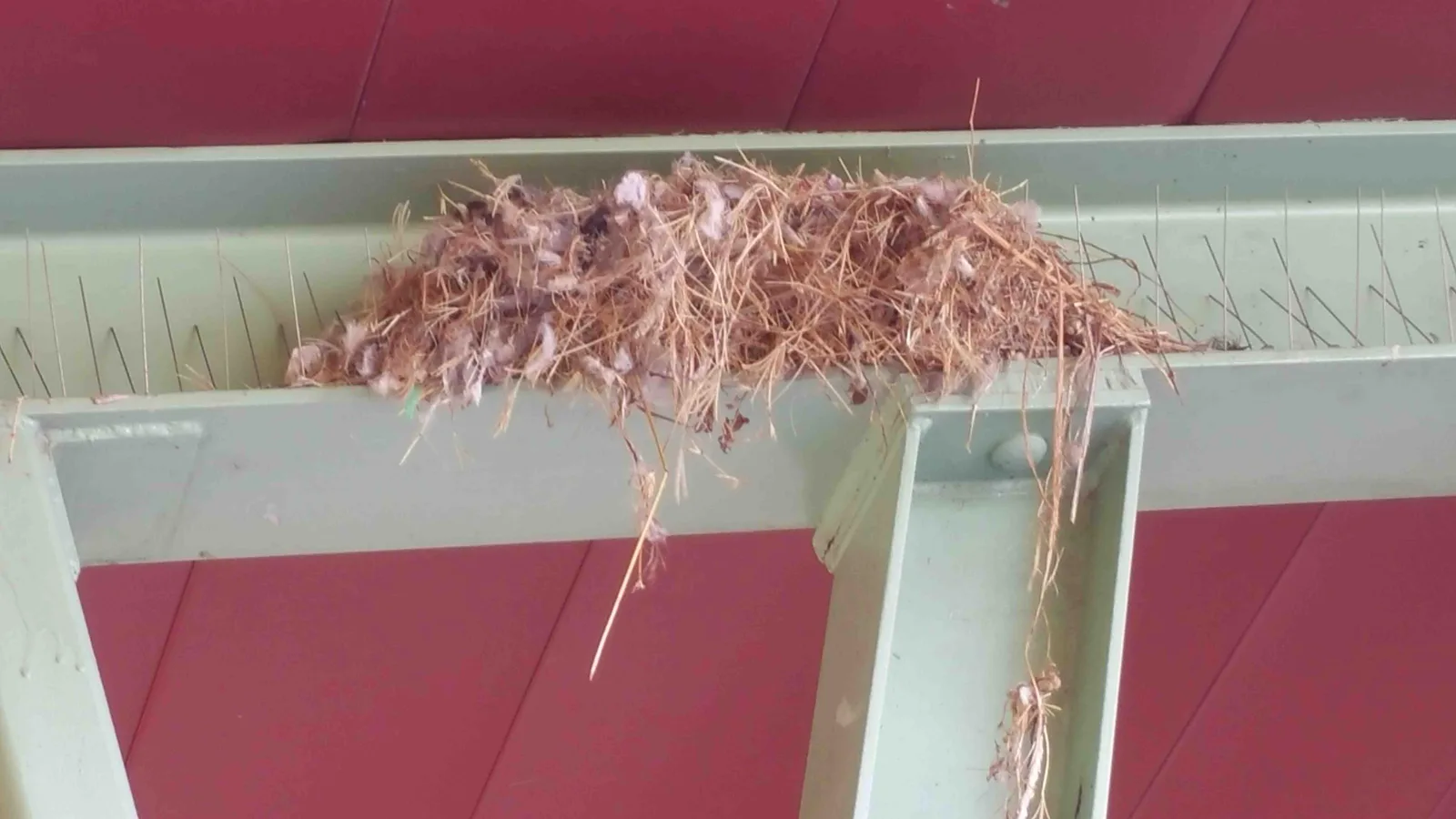
A house sparrow, a finch, or a similar small bird is a different problem. Its body is small enough, and its feet are light enough, that it can often land between the tines or tuck in at the very end where two sections meet, well behind the row’s actual reach. None of that requires unusual agility, only a gap sized for a bird twice its weight.
The photo above shows what that failure looks like in practice: a spike strip with a sparrow nest built directly across the top of the tines, straw and feathers packed into the spaces the row was supposed to deny. It’s one documented example of a common outcome: spikes spaced too widely for the bird using the ledge fail to deter it and can turn into a nest platform instead.
USDA-APHIS Wildlife Services describes anti-perching devices like spikes as standard, effective exclusion tools when they are properly installed and maintained for the target species, and notes that installation quality and ongoing upkeep are the main practical limits on how well they work (USDA-APHIS Wildlife Services, Use of Exclusion in Wildlife Damage Management). Proper installation for the target species is the part that gets skipped when a product bought for pigeons ends up on a ledge sparrows actually use.
Check the Ledge Before You Buy Anything
Buying spikes before you know what bird you’re dealing with is the most common mistake on a small-bird job. Work through this order first.
Watch the ledge for a few days. Note what’s landing there and whether it’s carrying food or nest material. A bird making repeated trips with a beak full of grass or feathers is building a nest.
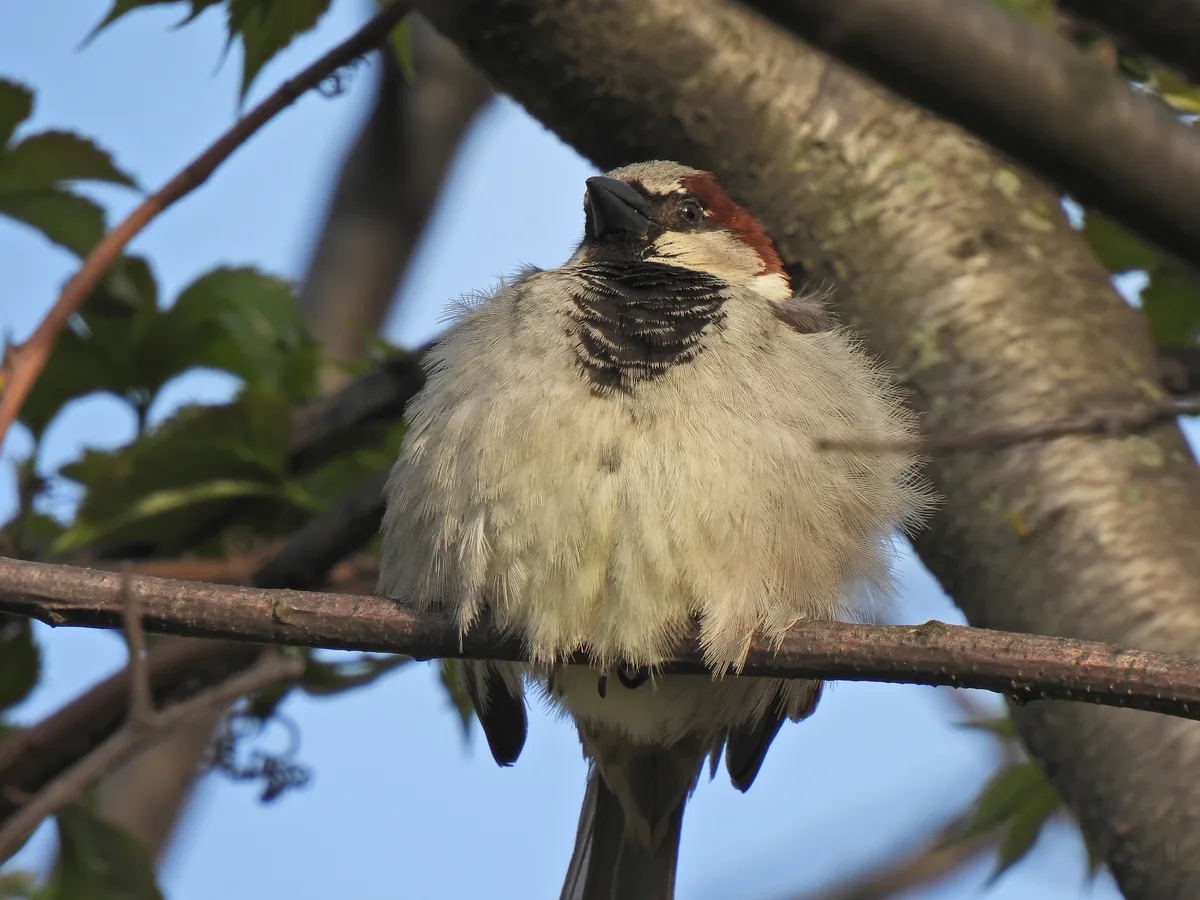
Identify the exact species. Size and coloring tell you which category you’re in. A stocky brown-and-gray bird with a black bib around a building’s eaves is very likely a house sparrow. A smaller, streakier bird with a different call could be a native sparrow, finch, or wren, which changes your legal options entirely (more on that below).
Measure the usable landing depth: front edge to wall or back edge, the ledge’s own depth regardless of the strip’s advertised width. A ledge deeper than the spike’s protected footprint leaves a safe lane behind the row no matter how tightly the tines are spaced.
Look for droppings, feathers, and old nest debris, which tell you the site has already been used and is likely to be used again if left open.
Only after that inspection does it make sense to ask whether a spike product is even the right category of tool. How to stop birds from nesting walks through the full inspection order, including the vents, soffits, and gutter corners that spikes were never designed to cover.
Which Small Birds You’re Actually Dealing With
This matters because it changes both your legal options and your best method.
House sparrows are the small bird homeowners run into most often on ledges, gutters, and building gaps. They are a non-native species and are not on the federal list of species protected under the Migratory Bird Treaty Act, so you generally do not need a federal permit to deter them, remove an inactive nest, or exclude them with a properly installed barrier (50 CFR § 10.13, List of Migratory Birds). State and local rules can still apply, so it’s worth a quick check with your state wildlife agency before assuming that’s the end of the question.
Native small birds are a different story. Chickadees, wrens, native sparrow species, and finches are covered by the Migratory Bird Treaty Act along with the vast majority of native North American birds. Harming one of these birds, or disturbing an active nest with eggs or dependent young, is illegal without a federal permit (16 U.S.C. 703).
The catch is that house sparrows and several native sparrows look enough alike that misidentification is common, and the law does not care whether the mistake was honest. If you are not confident in the species, treat the site as protected until you are, or ask your state wildlife agency to confirm. For the full breakdown of what’s protected and what isn’t, see Are Birds Protected by Law?
Confirm There’s No Active Nest First
Confirming this comes before you buy or install anything, not before you measure the ledge.
An active nest, meaning one with eggs, chicks, or dependent young still using it, cannot legally be disturbed or removed if it belongs to a protected species. That protection covers the nest structure itself as well as the birds inside it (U.S. Fish and Wildlife Service, Bird Nests). Installing spikes over or around an active nest, or trapping a bird behind a barrier meant to exclude it, can violate that protection regardless of intent.
Penalties are real. A misdemeanor violation of the Migratory Bird Treaty Act can bring a fine and jail time, and intent isn’t required for the lowest-level violation (16 U.S.C. 707). If a protected bird is actively using the site and the situation is a genuine health or safety problem, a limited permit may be available through the U.S. Fish and Wildlife Service under 50 CFR Part 21, but that’s a call to make with the agency, not a DIY judgment.
If the nest is confirmed empty and the bird is a non-native species like the house sparrow, or the native nest has been vacated and the young no longer depend on it, removal and exclusion work can generally proceed. When in doubt, wait a few more days and check again. A nest that looks abandoned in the morning can have an adult tending it by afternoon.
When Generic Spikes Can Still Help
Spikes can still work against small birds when the installation meets conditions many installs skip.
A narrow ledge, sill, or pipe with a tightly spaced product, installed across the entire usable width with no gap at the ends or behind the row, can discourage even a small bird from settling there, because there’s genuinely nowhere flat left to stand. Most failures trace back to partial coverage or spacing chosen for a bigger bird.
If you’re comparing products for a small-bird site, prioritize a denser tine pattern over a longer run of standard spacing, and treat the manufacturer’s stated coverage width as a starting measurement, not proof that the gaps between individual tines are small enough for the bird you watched on the ledge. Tine spacing tested against a named small-bird species is not something you can count on finding in product specs, so check the actual spacing yourself. Best bird spikes covers material, base design, and installation in more depth for the buying decision itself.
Where Spikes Fall Short for Small Birds
A few patterns show up again and again on small-bird jobs:
- Standard base spacing. Off-the-shelf spikes sized for pigeons often leave gaps a sparrow-sized bird can use without difficulty.
- Partial coverage. A short strip on the busiest section of a ledge leaves the rest open, and a small bird needs far less flat space than a pigeon to find a foothold.
- Nesting on top of the row. Loose material caught in the tines can build into a base a bird then nests on, turning the deterrent into a platform.
- Wide or open surfaces. Flat rooftops, patios, and open beams give a small bird room to land beside or around a strip instead of on it.
- No maintenance. A lifted, bent, or debris-packed strip stops doing its job even if it was sized correctly on day one.
Use spikes for small birds only when the fit matches the actual bird and the actual ledge, and keep up the maintenance.
Humane Alternatives That Handle Small Birds Better
When the site doesn’t meet the conditions above, a full barrier usually beats a landing deterrent.
Exclusion Netting Sized to the Bird
Netting closes off the whole space instead of just denying a landing spot, which sidesteps the fit problem spikes have with small bodies. The mesh has to be small enough that the target bird can’t pass through it, installed taut with no loose sections, and checked regularly so nothing gets tangled. Bird netting guide covers mesh sizing by species and the installation details that keep netting humane rather than a hazard.
Sealing Vents and Gaps Outright
If the small bird is getting into a vent, soffit gap, or wall cavity rather than perching on an open ledge, a spike was never the right tool. A fitted cover closes the opening completely. Confirm no bird or nest is inside first, since sealing an occupied cavity traps whatever’s in it. Dryer vents carry an added fire risk from trapped nest material, which is worth checking even if the bird problem seems minor. The vent and soffit exclusion steps cover the full walkthrough for sealing gaps like these.
Slope or Shield Covers Where They Fit
A flat ledge or beam can sometimes be covered with an angled shield instead of spiked. The angle removes the landing surface the same way spikes do, but without individual gaps a small bird can exploit, as long as the ends are sealed so nothing can tuck in behind the cover. This works best on beams, signs, and small flat fixtures where a full netting install would be overkill.
When the Job Needs a Professional
A few situations call for a licensed pest control or wildlife control professional instead of a weekend DIY attempt:
- Height and access. Anything above a single story, or requiring a ladder you’re not confident on, a lift, or scaffold, carries a fall risk that isn’t worth a bird problem.
- An active nest you can’t identify. If you can’t confirm the species or whether the nest is still in use, a professional or your state wildlife agency can make that call correctly the first time.
- Uncertain legal status. When a native and non-native small bird look similar enough that you’re guessing, get a confirmed identification before removing anything.
- A site that’s failed more than once. If you’ve already tried spikes or a barrier and small birds keep getting through, a professional can often spot the specific gap you’re missing faster than another round of trial and error.
For everything else, an honest inspection, the right barrier for the actual bird on the ledge, and a maintenance check a few times a year will do more for a small-bird problem than a longer row of spikes ever will.
Images: Bird control spikes with sparrow nest by Rselzer1, CC BY-SA 4.0. Male house sparrow perched in tree by Gedalya Lubman, CC BY-SA 4.0. Via Wikimedia Commons. Both photos were resized and converted to WebP from the originals; no other edits were made.


Free: The 5-Step Bird-Proofing Checklist
Work through the right steps in the right order, before spending money on the wrong deterrents. Printable PDF, straight to your inbox.
No spam. Unsubscribe any time.