How to Get Rid of Swallows (Before They Nest)
Contents[hide]
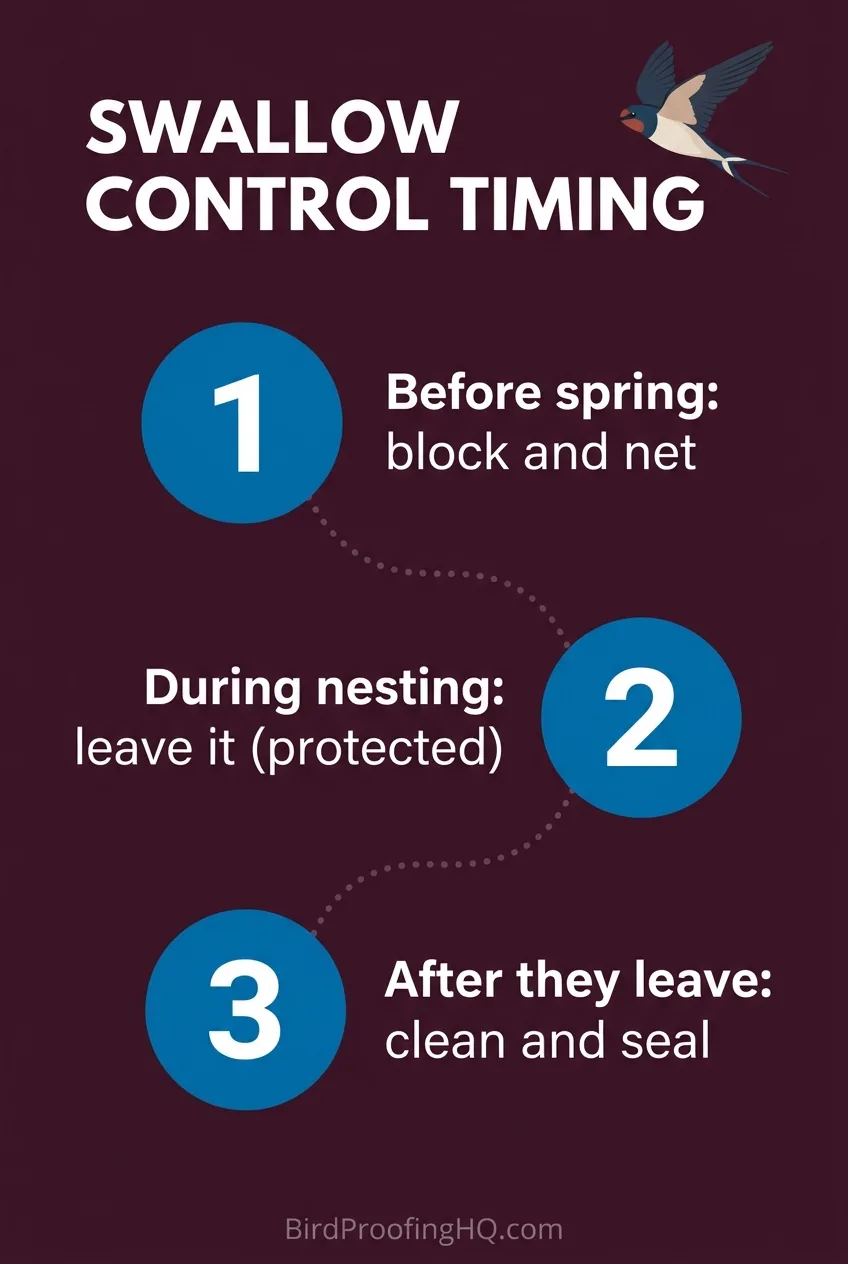
To get rid of swallows, act before they return in spring, usually before late March. Once eggs are in the nest, removal is federally illegal until the young have flown. Install netting under the eaves before they arrive. If a nest is already active, wait it out, remove it the day the birds leave, and install exclusion before next spring.
In this article, we’ll cover how to get rid of swallows before they arrive, what the law says once eggs appear, and how to seal the eaves afterward.
Why Barn Swallows Nest on Houses
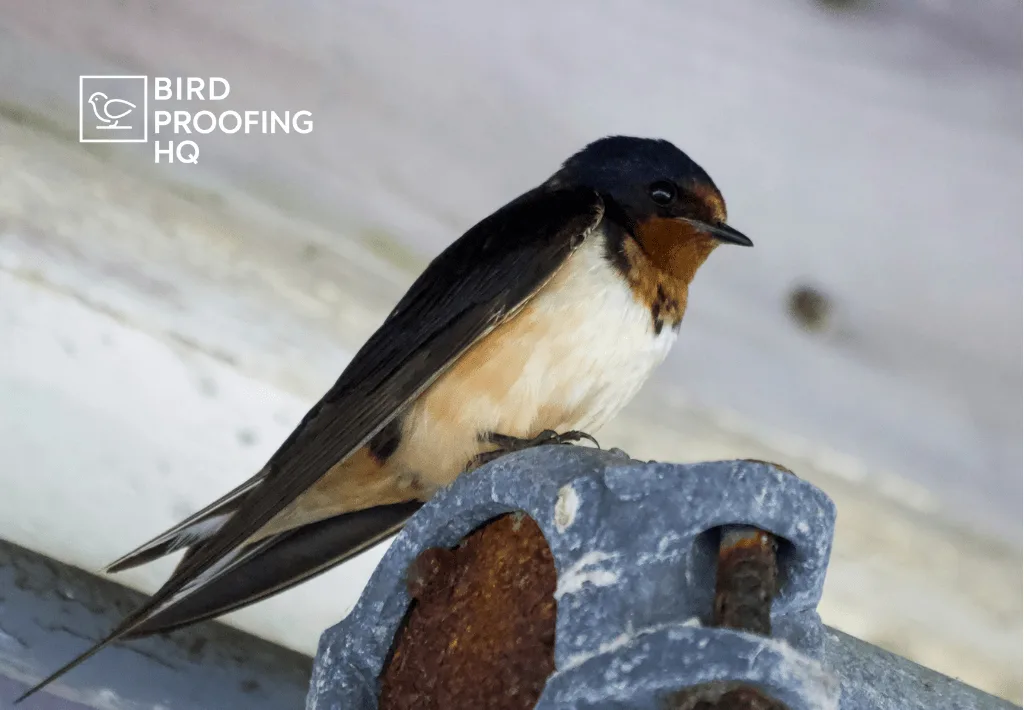
There are eight species of swallows in North America, but two cause nearly all the trouble: barn swallows and cliff swallows. Both are small, agile birds that build mud nests on vertical surfaces. And both decided long ago that human walls beat cliffs and caves in every way that matters.
Barn swallows build open, cup-shaped mud nests. They nest as single pairs or small groups under eaves, on porch beams, in garages, and inside barns. The barn swallow eviction playbook covers this species step by step. Cliff swallows, sometimes called mud swallows, build enclosed gourd-shaped nests and nest in colonies.
One cliff swallow colony can put dozens of swallow nests under a single roofline, which multiplies the mess fast. If you see clusters of mud nests packed side by side, you have mud swallows, not barn swallows. Exclusion then has to cover a much larger area.
Your house offers swallows three things they need: a sheltered vertical wall, an overhang that keeps the nest dry, and a steady supply of flying insects nearby. Swallows catch almost all their food in the air: mosquitoes, flies, moths, and beetles. They take nearly all their food on the wing, so a wet spring that produces more flies brings more swallows.
A pond, pool, garden, or open lawn near the house makes exactly the insect traffic these birds want. The swallows roost close to wherever the insects are.
Before barns and bridges existed, barn swallows nested in caves and on rock faces, not in trees. So a building’s smooth, sheltered walls are a real upgrade for them. That insect diet is also the honest case for leaving them be. A pair of barn swallows eats hundreds of bugs a day.
Plenty of people who learn this decide a nest over the shed or in a backyard tree is a fair trade. The real problem is location: mud nests above a front door, droppings on a patio, feathers on the deck, and protective birds that swoop at you during nesting season. Either way, the goal is never to harm the birds. It is to move them somewhere better.
The Legal Status of Swallow Nests
Barn swallows and cliff swallows are protected under the Migratory Bird Treaty Act of 1918, often shortened to the Migratory Bird Act. Under this federal law:
- It is illegal to knock down an active nest (one with eggs or chicks in it).
- It is illegal to harm the swallows, their eggs, or their babies.
- Violating these protections is a federal offense carrying fines and potential criminal penalties. The rules apply to every nest in a colony too: fifty swallow nests with eggs are fifty violations, not one.
What you can legally do: remove an empty nest, install exclusion measures before the birds start building nests, and apply repellents to prevent initial nest construction. The legal status changes the moment eggs appear, so acting before or after the breeding season keeps everything you do legal.
This is the single biggest difference between swallow control and most other bird control. With pigeons or starlings, you can act whenever you want. Nesting swallows are different, because federal law sets your calendar. What was perfectly legal in February becomes illegal in May.
When Swallows Arrive (and When to Act)
Swallows spend the winter in Central and South America and fly back north in spring. Arrival timing varies by location:
- Southern US states: late March to early April
- Northern US and Canada: mid April through May
The birds depart in August and September, gathering in large flocks of barn swallows before migration. This gives you a long autumn-and-winter window to install exclusion, remove old nests, and prepare surfaces before the swallows return.
The most common mistake is waiting until swallows appear, then scrambling to install deterrents. Barn swallows show strong site fidelity. The same birds return to the same nesting sites year after year, and old nests become starting points for new building.
By the time you see swallows carrying mud pellets to a wall, you may have only days before eggs are laid. Install exclusion in fall, or by mid-February at the latest.
How to Stop Swallows From Nesting
Block the wall before they glue a nest to it. These are the methods that hold.
Bird Netting
Plastic owls and ultrasonic boxes do almost nothing against swallows. Bird netting is the one method that actually holds. It stops swallows from reaching eave surfaces and building nests.
The principle is simple: netting eliminates the sheltered vertical surface swallows need for mud nest construction. No surface, no nest, no swallow problem.
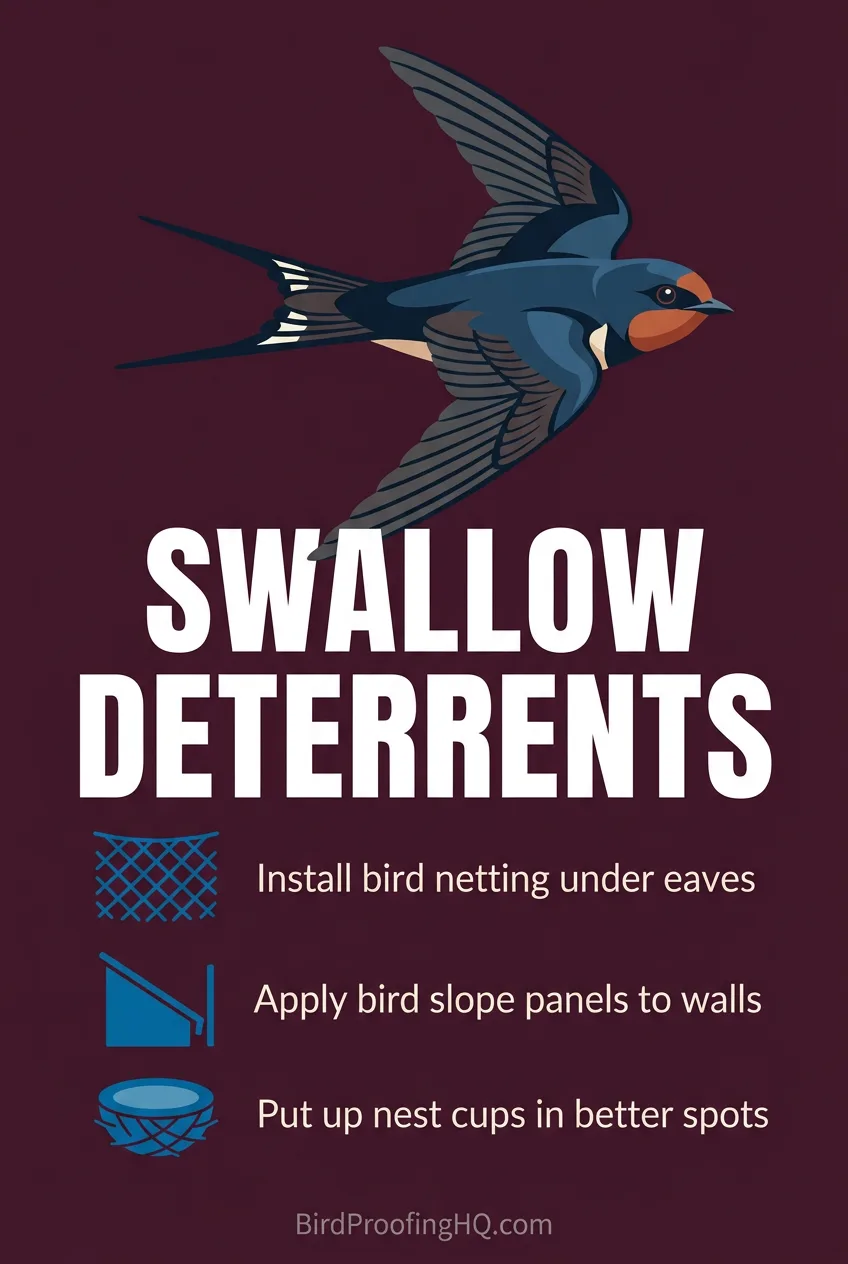
How to install it: Run netting from the roofline overhang down to the exterior wall. Angle the bottom outward so there is no gap for the birds to squeeze through. Secure the top to the fascia, and the sides and bottom to the wall, with staples or netting clips. Keep it taut, with no sections sagging away from the wall.
Use netting with a mesh of half an inch or less so swallows cannot push through it or get their feet through it. Larger mesh lets the birds find purchase and pull the netting aside.
Netting works for barn swallows under home eaves and for cliff swallow colonies on commercial buildings. Check it each autumn. Returning barn swallows probe last year’s swallow nests first, and loose netting near old nest scars is where they break through.
For a site used for years, netting is realistically the only DIY method that holds. The birds treat that wall as one of the few good nesting sites around, and they will test every gap.
Bird Spikes and Slope Panels
For narrow ledges, window sills, and beam faces where netting is impractical, bird spikes and slope panels are the next tools to reach for.
Bird spikes eliminate flat landing surfaces. Swallows prefer to start nest construction from a stable perch, and spikes make landing uncomfortable enough that most birds move on to a better site. Install them on any flat horizontal surface within the nesting zone, including ledges, beams, and light fixtures.
Slope panels are angled covers that turn a flat surface into a slope too steep for mud to stick. They work well on horizontal ledges and beam soffits where spikes would be impractical. Cliff swallows in particular need a wall-to-overhang junction to anchor their nests. A slope panel removes that junction entirely. Now there is nowhere for a nest to stick, no matter how persistent the birds are.
For surfaces these two will not handle, a few other bird deterrents round out the kit by surface type.
Visual Deterrents and Repellents
Visual deterrents and repellents will not get rid of a determined pair on their own, but they meaningfully improve the odds when combined with exclusion. Deterring swallows works best as a layered system: block the surface, then make the whole area feel unwelcoming.
Methyl anthranilate (MA) is the most effective registered repellent for swallows. It is a grape-derived compound that irritates birds on contact without hurting them. MA products like Detour, Bird-Out, and Avian Block pouches go on surfaces where swallows try to land. You can also use them as an area treatment in semi-enclosed spaces like porches, garages, and carports. They are non-toxic and safe around people and pets. Plain smell-based repellents like peppermint oil do little to swallows, though a natural bird repellent can help against other species.
Visual deterrents add pressure at the nest site. Mylar tape fluttering at the wall line, reflective spinners, and hawk silhouettes all make a calm nesting spot feel unsafe. Move them every few days so the swallows do not get used to them.
Distress calls are less useful against swallows than against starlings or crows. But a motion-activated sound device near a problem wall can help during the scouting phase, before any mud goes up.
One folk remedy has some truth to it: fresh paint. Swallows have a harder time getting mud to stick to very slick surfaces. A high-gloss coat on a rough wall section makes nest building harder. It will not stop a determined pair on its own, so treat it as backup under an overhang you cannot net.
Swallow Control During an Active Nesting Season
If swallows are nesting on your property with eggs or chicks, the law freezes your options until the young have flown. Here is what you can do:
- Wait. The cycle from egg-laying to fledging typically takes six to eight weeks. Mark your calendar from the day you first observe eggs, and remember the chicks themselves are protected the entire time.
- Document the nest location. You will want to remember exactly where to install exclusion after the birds leave.
- Clean droppings from the ground and patio during the season using gloves, a damp cloth, and a mask. Wet methods are safer than dry sweeping.
- The same day the birds depart, remove the nest wearing gloves and dispose of it sealed in a plastic bag. Swallows reuse old nests as starting points, so prompt removal of every empty nest breaks the cycle.
- Install exclusion that same week, before scouts return to evaluate the wall for next spring.
One more reason the gloves are not optional: old nests harbor bird mites and swallow bugs (close relatives of bed bugs). Both will wander indoors looking for a new host after the birds leave.
A note on behavior: nesting swallows will swoop at people and pets near the nest, especially while the adults are hunting to feed chicks. They almost never make contact. It is a bluff to move you along. It stops once the chicks fledge and the family moves to a communal roost before migration.
Cleaning Up After Swallows Leave
Bird droppings accumulate fast below swallow nests, along with feathers and mud fragments. After the birds depart:
- Remove the empty nest immediately (gloves, sealed plastic bag, outdoor bin).
- Wash the wall with a cleaning solution: diluted bleach or an enzyme cleaner both work. Scrub off remaining mud so returning birds find no foundation to build on, then wash the area below the nest site too.
- If droppings have accumulated on the ground, porch, or roof below, wet them thoroughly before sweeping so dried material does not become airborne.
- Check the area for mites for a week or two after removal, especially if the nest was near a window or door. Mites leave when the birds do, and your skin is the nearest replacement.
Once the surface is clean and dry, install your exclusion measures before the end of October. Handle this in autumn and you almost never see the problem repeat. Wait until the swallows are back in spring, and you usually get one more year of mud nests, droppings, and feathers.
When to Call a Bird Control Professional
Sometimes barn swallows or a cliff swallow colony have used the same site for years and DIY exclusion has not held. A licensed bird control or wildlife company can assess the site and install commercial-grade netting and barriers. Multi-year colony sites on commercial buildings are genuinely hard to clear with consumer products, and the nuisance scales with the colony.
Removing an active nest requires a federal depredation permit, which is special permission to remove a protected nest. It is granted only for documented health or safety issues. For that, a licensed wildlife operator or your local USDA Wildlife Services office is the right resource.
No reputable professional will knock down an active swallow nest without that permit, and neither should you. These protected nests are not worth a federal fine.
If other birds are eyeing your eaves, the same timing applies. Stopping birds from nesting walks through exclusion across species, from pigeons to protected swallows. For the barrier options by structure type, bird-proofing your home covers ledges, trees, and eaves alike.
If swallows are not your only problem, the bird-by-bird hub routes you to the right guide.
Images: barn swallow via Wikimedia Commons. Infographic by BirdProofingHQ.
Free: The 5-Step Bird-Proofing Checklist
Work through the right steps in the right order, before spending money on the wrong deterrents. Printable PDF, straight to your inbox.
No spam. Unsubscribe any time.