How to Get Rid of Barn Swallows (Without Breaking the Law)
Contents[hide]
- 1. Why Do Barn Swallows Keep Nesting on Your House?
- 2. Are Barn Swallows Protected by Law?
- 3. How Do You Get Rid of Barn Swallows?
- 4. How to Stop Barn Swallows From Rebuilding in Spring
- 5. Barn Swallows or Cliff Swallows: Which Do You Have?
- 6. Do Barn Swallow Nests Cause Any Real Harm?
- 7. When to Call a Professional
To get rid of barn swallows, wait until the nest is empty, remove it the same day, and block the surface so they cannot rebuild. Netting between the eave and the wall works best. Active nests with eggs or chicks are federally protected, so the work happens in fall, not spring.
In this article, you'll learn how to deter barn swallows without breaking the law. We'll cover removal timing, netting setup, and spring prevention.
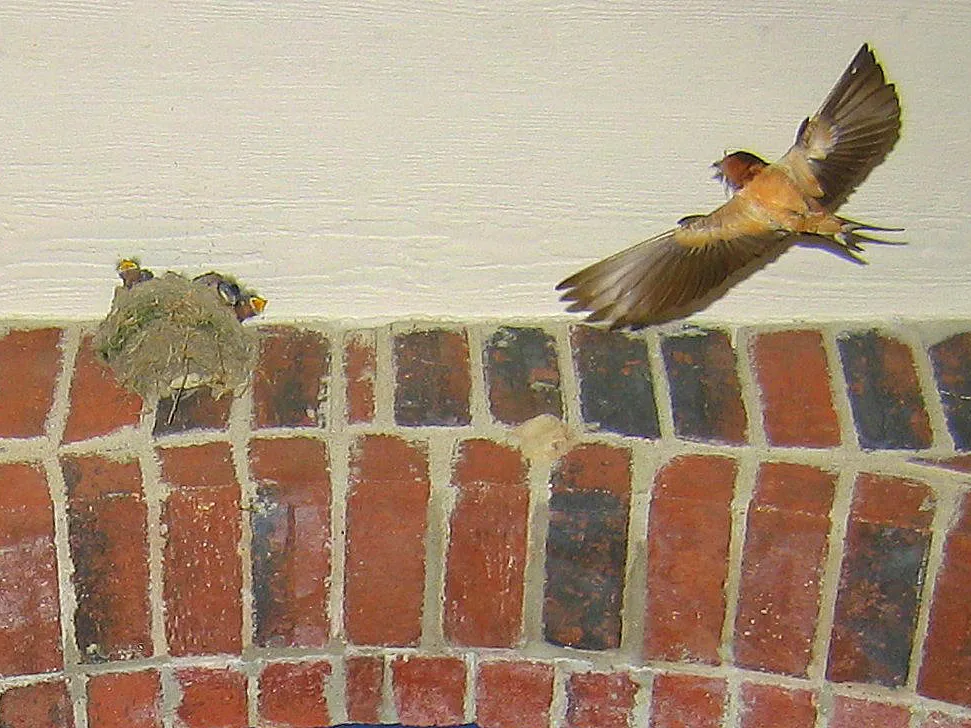
Why Do Barn Swallows Keep Nesting on Your House?
Barn swallows nested on cliffs and cave walls long before buildings existed. A porch beam, a garage rafter or door track, or an eave gives them everything those cliffs did. There is a vertical surface, an overhang against the rain, and open air nearby full of flying insects.
Once a pair succeeds at a site, you have a long-term tenant. They return to that spot every spring after wintering in South America, and their young often settle within sight of where they hatched.
The Cornell Lab of Ornithology tracks this loyalty. It is the most important fact in this whole fight: you are not deterring a random bird, you are evicting a family with a lease.
Old nests make it worse. A leftover mud cup from last year is a ready-made starter home. Returning birds patch it with fresh mud instead of building from scratch. Every empty nest you leave up is an invitation.
What Attracts Them to One Wall and Not Another?
Swallows pick spots with a rough vertical surface for mud to grip, protection from rain, and a clear flight path in. A wall under a deep eave near a pond, pool, or open lawn is prime real estate. The insect supply nearby is their food source. Fresh paint and slick surfaces get passed over, which is worth remembering later.
Are Barn Swallows Protected by Law?
Yes. Barn swallows are migratory birds protected under the Migratory Bird Treaty Act. The law is specific about what that means for a homeowner:
- An active nest, one containing eggs or chicks, cannot be removed, moved, or destroyed.
- The birds, their eggs, and their young cannot be harmed.
- An empty nest has no protection and can be removed at any time.
The legal status of the same mud cup changes with what is inside it. In February it is debris you can scrape off. In May, with eggs inside, it is a federally protected nest and knocking it down is a crime that carries real fines.
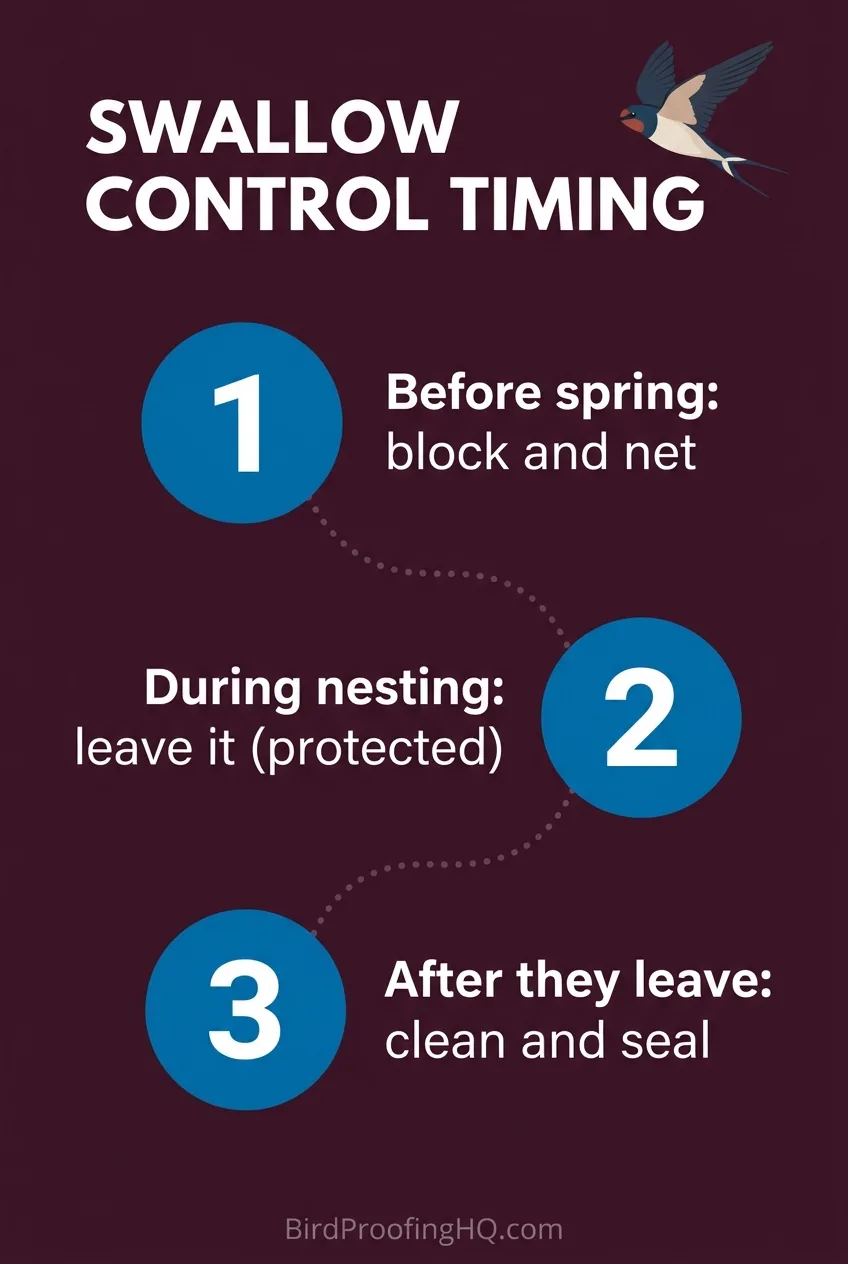
What If the Nest Is Already Occupied?
You wait. From egg-laying to the chicks leaving takes roughly six to eight weeks, and barn swallows often raise two broods in a summer. Mark the date you first see eggs and watch for the young to fly in late summer. Plan the removal for the day the nest goes quiet.
A wildlife control professional can obtain a depredation permit for genuine health or safety problems. For a porch nest, no legitimate operator will touch it while it is occupied.
How Do You Get Rid of Barn Swallows?
How to get rid of barn swallows comes down to three moves, in order. Remove the empty nests, block the surface, and add a repellent layer where blocking is not possible.
Remove Old Nests the Day the Birds Leave
Swallows depart in August and September. That same week, put on gloves and a dust mask, scrape every mud nest off the wall, and bag the debris.
Old nests harbor bird mites and swallow bugs, close relatives of bed bugs. Both wander indoors looking for a new host once the birds are gone. The gloves are not optional.
Then wash the wall. Scrub the mud scars off with a stiff brush and soapy water, because visible nest remnants are the landmark returning birds look for.
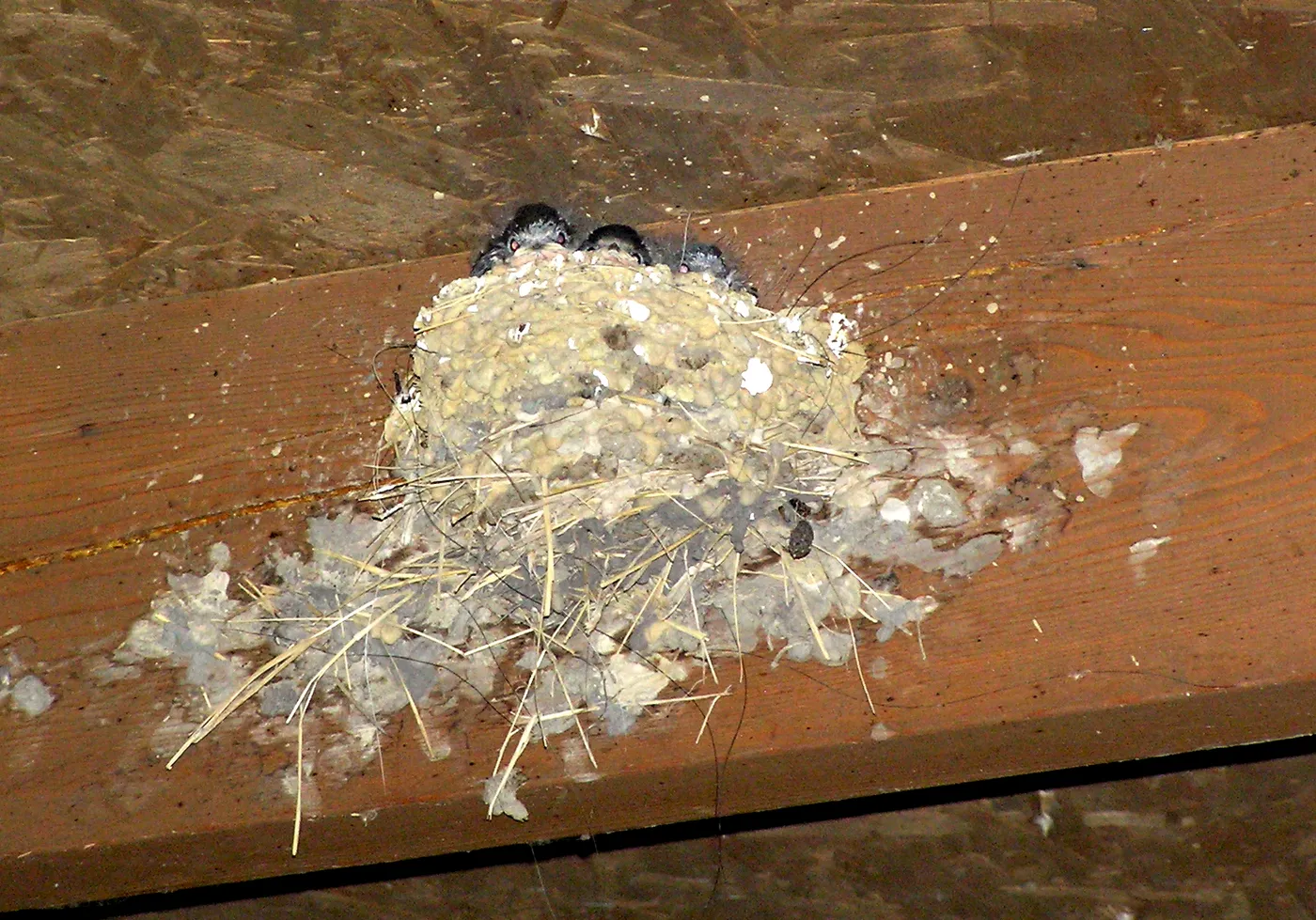
Install Bird Netting Between the Eave and the Wall
Netting is the one fix that reliably ends a multi-year swallow problem. Run bird netting from the outer edge of the eave down to the wall at an angle. This closes off the sheltered corner they nest in.
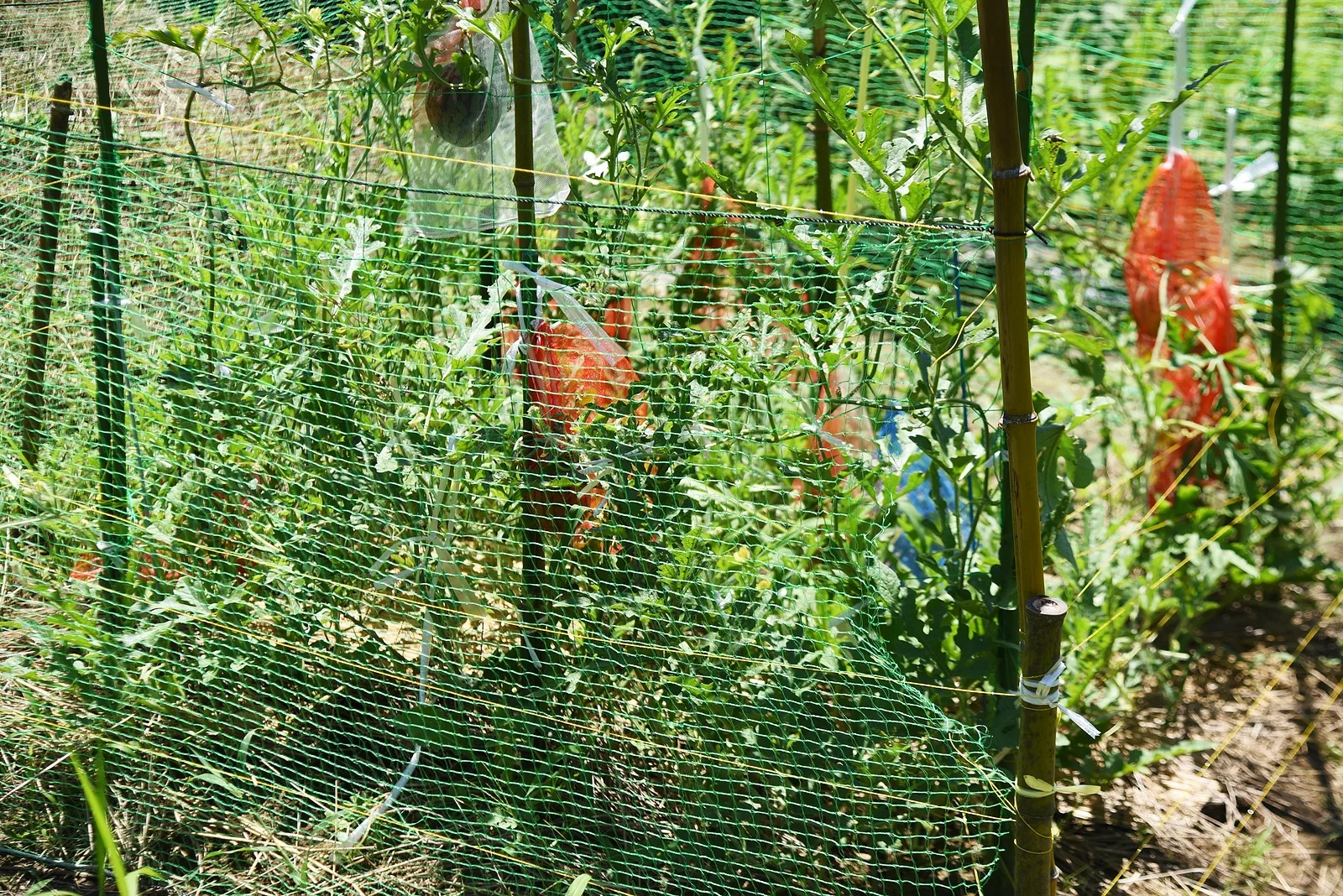
Use mesh of half an inch or smaller, pull it taut, and fasten every edge. Swallows will probe any gap near an old nest site.
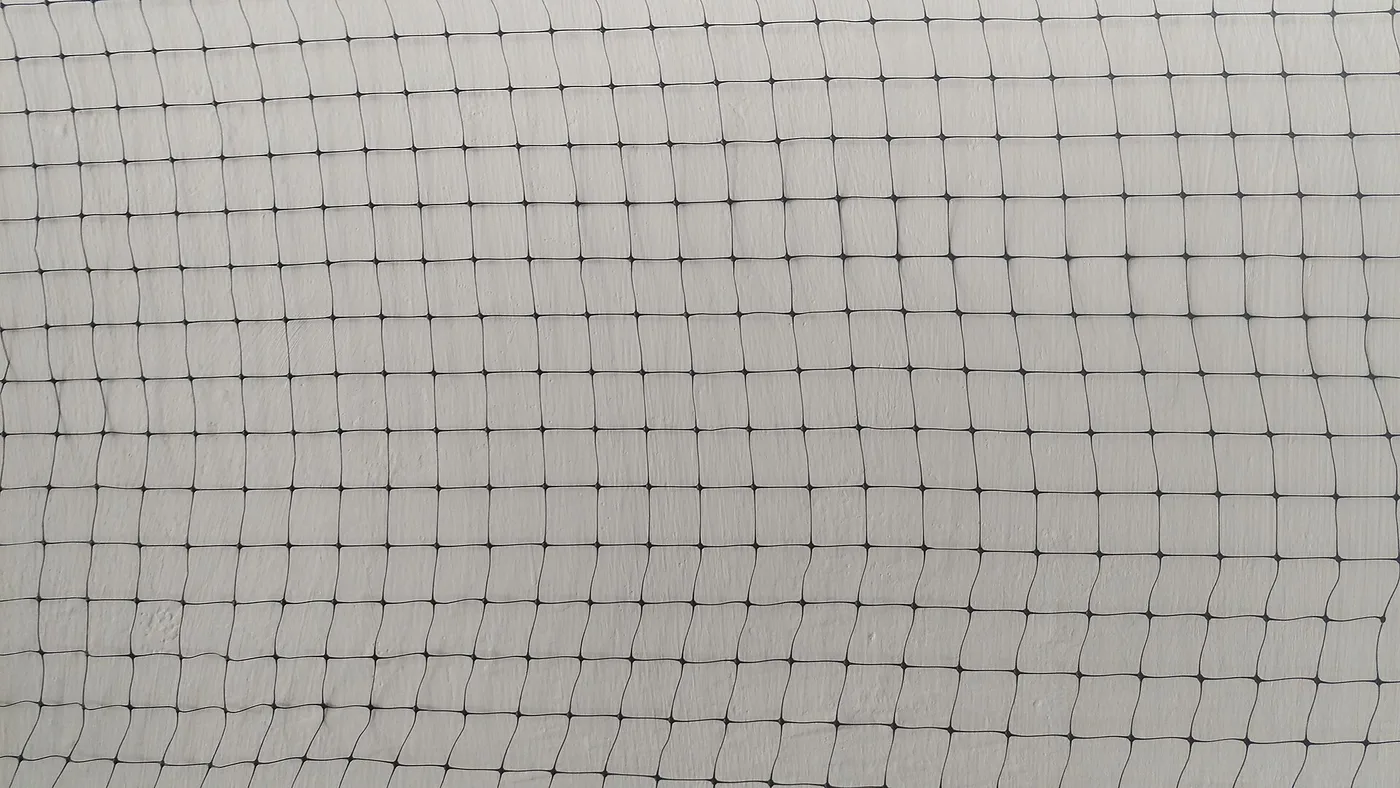
Check it each spring before the birds return. A sagging section or a loose corner is exactly where a determined pair breaks through.
Use Slope Panels and Repellents Where You Cannot Net
Bird slope panels turn a flat ledge or beam corner into a slide too steep for mud to stick. They suit porch beams and light fixtures where netting would look wrong.
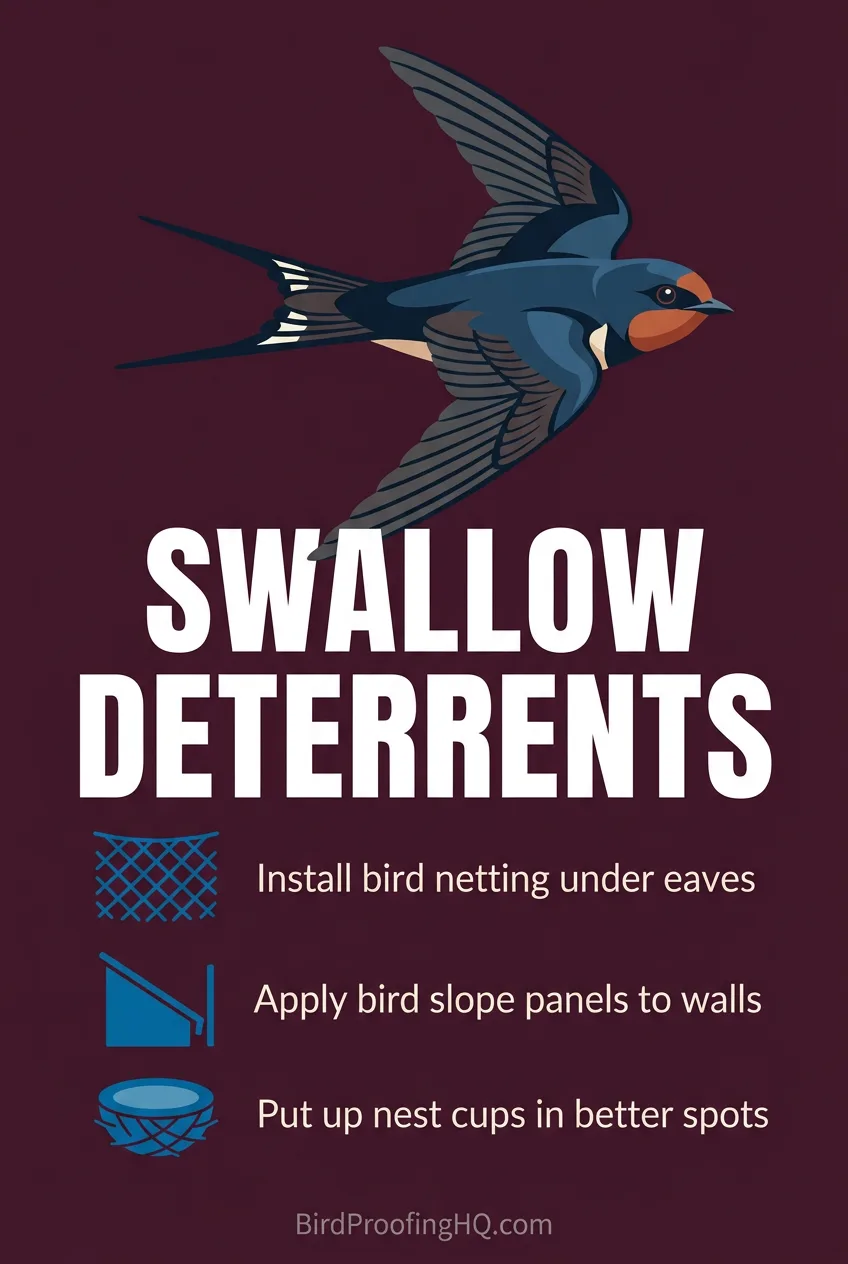
For surfaces you cannot cover at all, methyl anthranilate spray adds a fallback layer. It is a grape-derived compound that irritates birds without harming them, sold under names like Detour and Bird-Out. Reapply it after rain.
A homemade peppermint or vinegar spray uses that irritation trick for free. It fades within a day or two outdoors, so plan on reapplying it far more often than the commercial version. A high-gloss paint coat on a favorite wall section also makes it harder for mud to stick, though it will not stop a committed pair on its own.
How to Stop Barn Swallows From Rebuilding in Spring
Your barriers only work if you check them before spring. Before the birds return in late March, walk the property. Confirm the netting is still tight, gap-free, and anchored, and check the old nest sites for mud remnants or new construction starting.
Then cover the scouting spots. Hang reflective tape or a couple of old CDs near last year’s sites for the first weeks of the season. Move them every few days so the birds do not get used to them.
If a pair starts building anyway, act while the nest is mud-only. Knocking down a half-built, empty nest is legal, and most pairs give up after two or three failed attempts and move to an easier site. Once an egg appears, the window closes for the season.
Barn Swallows or Cliff Swallows: Which Do You Have?
The fix is the same, but the scale is different, so it is worth a look before buying materials. There are eight species of swallows in North America, and two build mud nests on buildings.
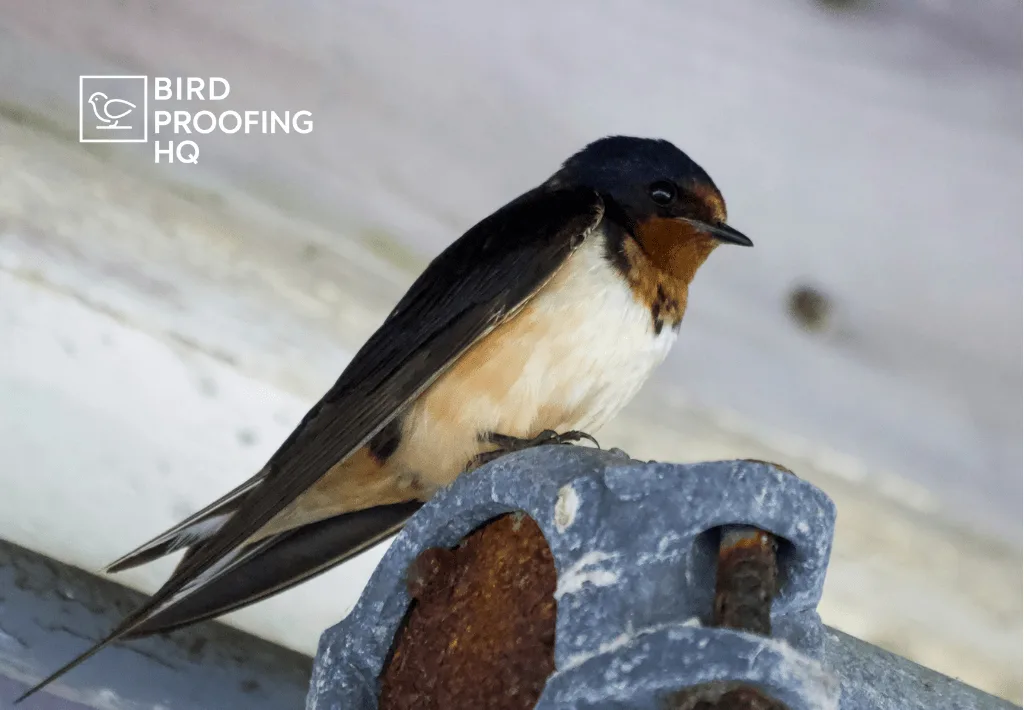
Barn swallows build open, cup-shaped nests, usually one pair per site, and have deeply forked tails. Cliff swallows build enclosed gourd-shaped nests with a small entrance hole, nest in colonies that can pack dozens of nests under one roofline, and have squared-off tails.
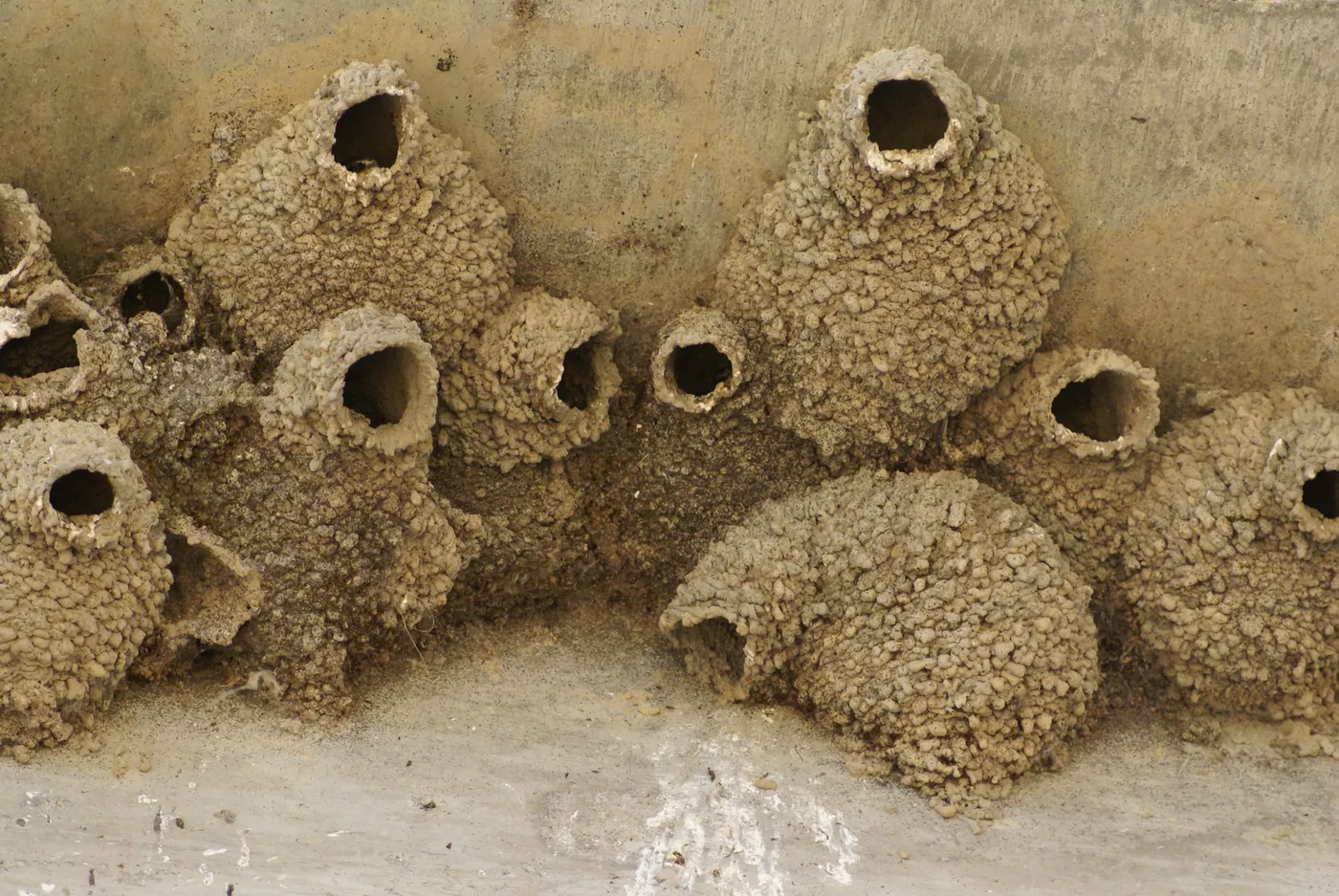
One or two open cups over the porch means barn swallows, and the steps above handle it. A row of gourd-shaped nests packed side by side means cliff swallows, and the netting job covers a much larger area. The general swallow guide covers cliff swallow colonies in more depth.
Do Barn Swallow Nests Cause Any Real Harm?
Mostly the problem is mess and location. Droppings pile up directly under the nest, which is miserable over a doorway and a genuine slip hazard on a deck. The droppings can also harbor the fungus behind histoplasmosis, so wet-clean them with gloves rather than dry-sweeping.
The nests themselves carry mites and swallow bugs, covered above. Beyond that, the birds earn their keep: a pair eats hundreds of mosquitoes, flies, and moths every day. If the nest is on a shed or a tree line away from your living space, the cheapest option is to leave it alone and enjoy the free pest control. If birds are hitting your barn or outbuildings instead, the barn bird control guide covers that scenario.
When to Call a Professional
Call in a pro when the site has years of history and DIY netting has failed. That goes for nests three stories up too, or a cliff swallow colony on a commercial building. A licensed bird control specialist installs commercial-grade netting with proper tensioning, and knows the permit process for the rare case where an occupied nest is a documented safety hazard.
For everything else, the calendar is your main tool. Remove the empty nests in fall, net the eaves before March, and even a long-running problem ends in one season.
Images: Barn swallow with nest by Sarum blue, CC BY-SA 3.0. Baby barn swallows by Montanabw, CC BY-SA 4.0. Cliff swallow colony by Ron Hinchley, CC BY-SA 3.0. All via Wikimedia Commons. Infographics by BirdProofingHQ.


Free: The 5-Step Bird-Proofing Checklist
Work through the right steps in the right order, before spending money on the wrong deterrents. Printable PDF, straight to your inbox.
No spam. Unsubscribe any time.