In this guide7 sections
Quick Answer
Yes. Barn swallows are protected by the federal Migratory Bird Treaty Act, so you can't destroy a nest with eggs or chicks without a federal permit. An empty nest can be removed under federal rules, but check state and local rules first.
In this article, you'll learn when you can legally remove a barn swallow nest. We'll cover federal protection basics, active versus inactive nests, and safe timing.
What the Federal Rule Says
The U.S. Fish and Wildlife Service (FWS) says all swallows are protected under state law and the federal Migratory Bird Treaty Act. That covers the bird, its eggs, and its nest. An active nest can’t be destroyed without a permit, and the narrower rules for an empty nest are below. Treat this as the federal baseline, not legal advice. Your state or town may add rules of its own.
Make Sure It Is a Barn Swallow
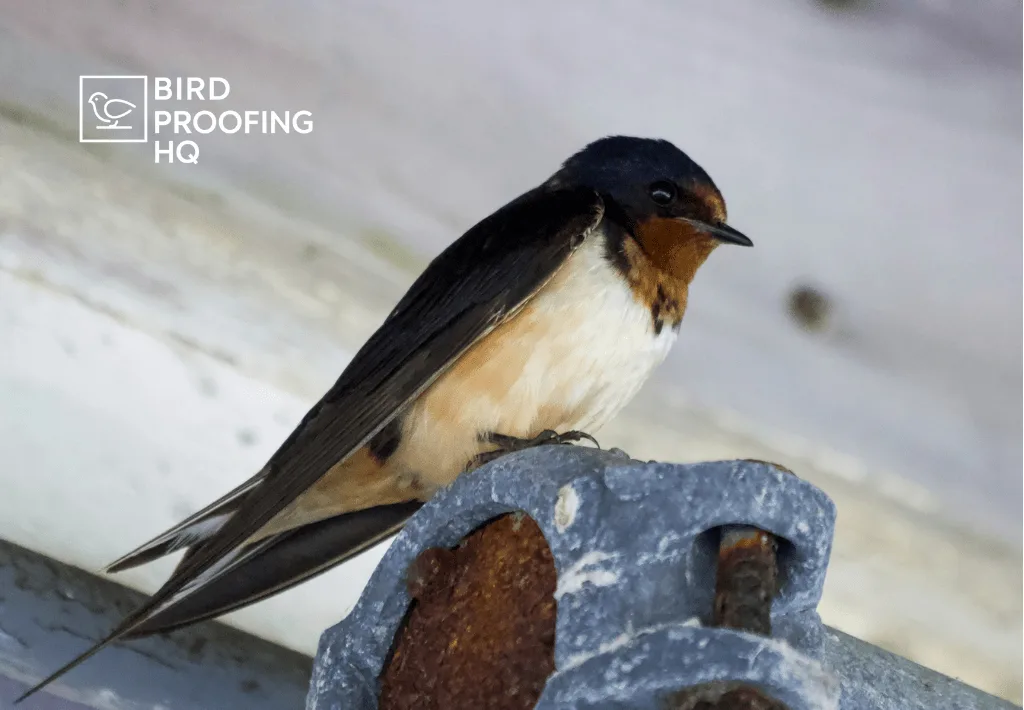
Barn swallows have a deeply forked tail and build an open cup of mud. Cornell Lab of Ornithology says they nest on eaves, rafters, crossbeams, bridges, wharves, and culverts, which is why they end up on porches, garages, barns, and under docks. Identify the bird first, and take a second look before relying on anything here if the nest doesn’t match that description.
Is the Nest Active? A Simple Decision
The contents of the nest decide what you can do. The month on the calendar doesn’t. Nesting times shift with location and weather.
| What you see | Status | What to do |
|---|---|---|
| Eggs, chicks, or young still relying on the nest | Active | Leave it alone. Destroying it is illegal without authorization. |
| Adults building, and you can clearly see there are no eggs or chicks | Not active under the federal definition | Removing newly placed mud and blocking access may be federally allowed, if state and local rules allow. Stop the moment an egg appears. |
| Adults visiting repeatedly and you can’t see what is in the nest | Uncertain, so treat as active | Keep watching. Don’t disturb it. |
| No eggs or chicks visible, and no adult visits over several days of checking | Possibly inactive, but not proven empty | Quiet visits don’t prove the nest is empty. Confirm you can see inside, and if you can’t, treat it as active. Federally removable once confirmed, if state and local rules allow. |
| Hazard that can’t wait | Active or unknown | Stop and contact the permit office. See When You Need a Permit below. |
How to Check Without Touching Anything
Watch from a distance, ideally with binoculars, at a few different times of day. Adults flying in and out can mean building, incubating, or feeding young, so traffic alone does not prove a nest is empty.
Look for eggs or chicks only if you can see them without touching the nest. Never climb a ladder, reach in, or poke at the nest to find out. If a safe ground-level check cannot confirm what is in the nest, call a qualified wildlife-control professional rather than climbing or probing. Also look around for fledglings. Under the FWS rule, a nest that young birds still rely on is off limits.
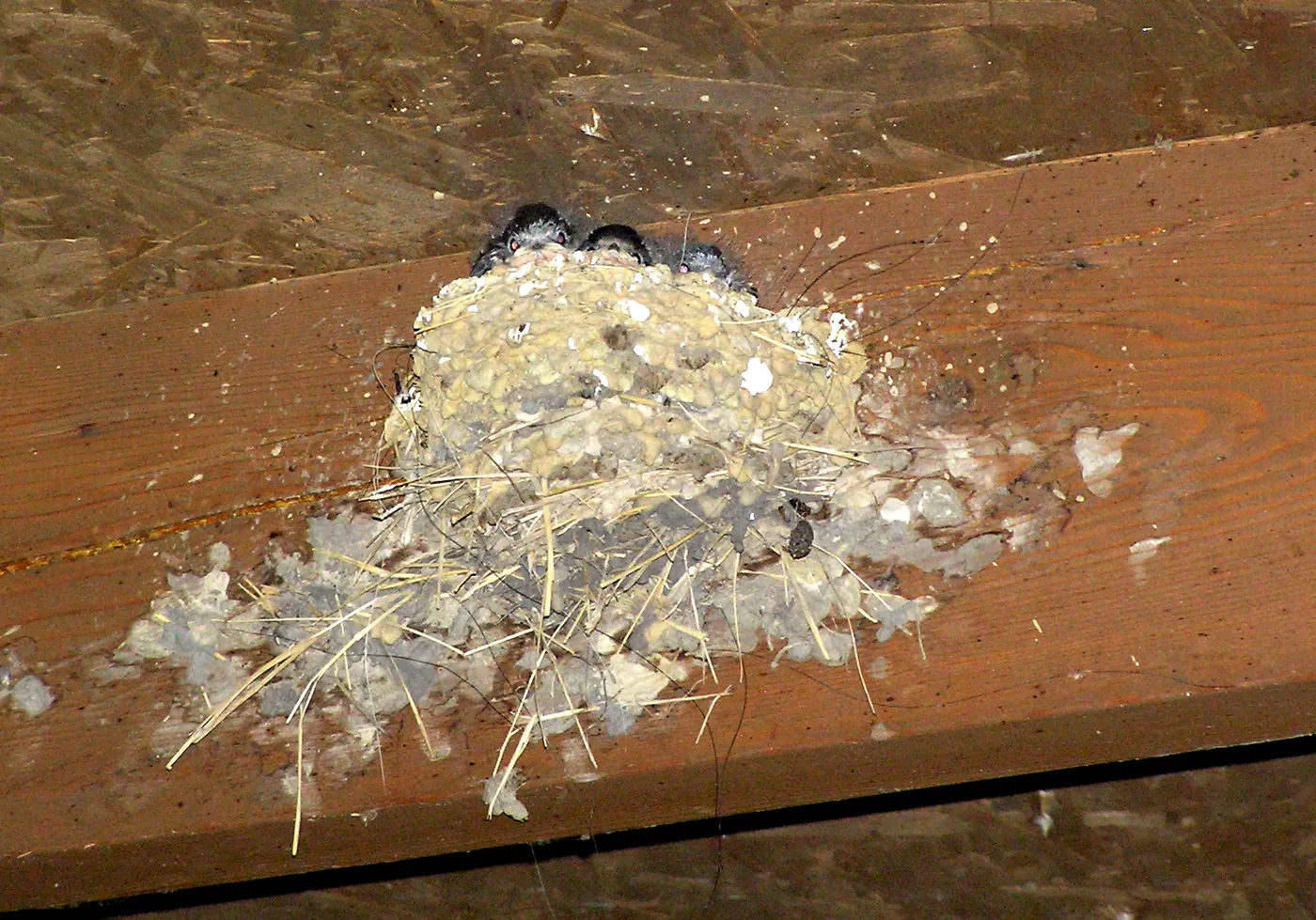
If you aren’t sure, assume the nest is active. Waiting a few more days costs far less than a violation.
Removing an Inactive Nest
The FWS depredation FAQ says an inactive nest is one without eggs or chicks, and no permit is needed to destroy it. The condition is that the inactive nest must be destroyed, not kept.
This is the federal position. FWS also tells readers to check with their state government, so call your state wildlife agency before you scrape anything down. Don’t assume that an empty nest is automatically fair game everywhere.
When You Need a Permit
If a nest is active and you want it gone, you’d need authorization from FWS. FWS says applications need strong, compelling reasons, such as human or bird health or safety hazards or property damage. A mess under the nest, noise, or a dislike of birds near the door usually won’t be enough. A permit isn’t guaranteed, and you should not touch the nest until you have an answer.
For a non-urgent nuisance like this, you can live with the nest while you wait. Temporarily moving a doormat, a car, or other movable items out from under it is a low-risk way to cut down the mess. This does not apply to urgent hazards.
If the nest creates an urgent fire, electrical, structural, sanitation, or access hazard, stop disturbing it. Contact the FWS Migratory Bird Permit Office for your region plus your state wildlife agency, or hire a qualified wildlife-control professional who knows the permitting rules. Describe what the hazard is and where the nest sits.
Preventing Nests Before the Next Season
The easiest time to deal with swallows is before they have eggs. FWS recommends removing old nests and mud traces, using netting where appropriate, and acting before egg laying. Old nests matter because Cornell notes that barn swallows may reuse nests from earlier years.
The same fact sheet says repellents are not effective on swallows and that no toxicants are registered with the EPA for swallow control. Skip the sprays, gels, and poisons. Closing off the nesting spot with a physical barrier is what lasts.
Once the nest is confirmed inactive, clean the spot and install the barrier before the birds return. For mesh sizes, placement, and what to do about different structures, see how to get rid of barn swallows. If birds are already building, the broader steps in how to stop birds from nesting apply only until the first egg appears. After that, leave the nest alone.
For the wider picture on other species, are birds protected by law covers the general rules.
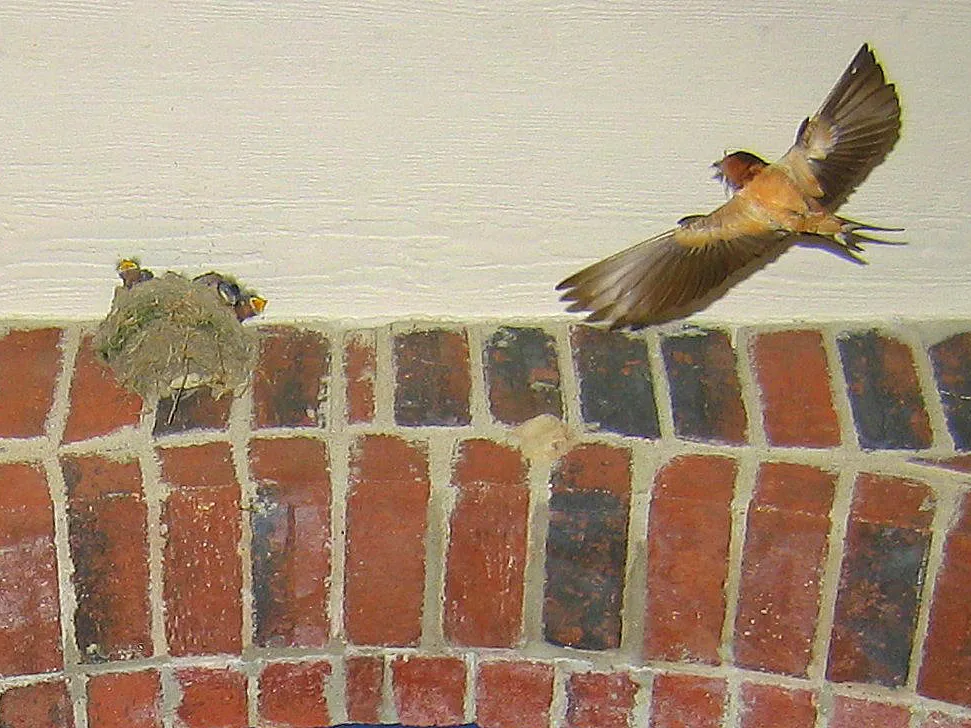
Images: Barn swallow with nest by Sarum blue, CC BY-SA 3.0. Baby barn swallows by Montanabw, CC BY-SA 4.0. Both via Wikimedia Commons.
Frequently Asked Questions
Is it illegal to knock down a barn swallow nest?
It is illegal without a federal permit if the nest has eggs or chicks, or if young birds still depend on it. An inactive nest, one with no eggs or chicks, doesn't need a federal depredation permit to destroy. State and local rules can still apply, so check them first.
Can I remove an empty barn swallow nest?
Federally, yes. The U.S. Fish and Wildlife Service says an inactive nest can be destroyed without a depredation permit, as long as it is destroyed and not kept. Confirm that nothing in your state or local rules says otherwise, and be sure the nest is really empty.
Can I get a permit to remove an active barn swallow nest?
Possibly, but a permit is not guaranteed. Applications need strong, compelling reasons, such as a human or bird health or safety hazard or property damage. Annoyance and droppings alone are unlikely to meet that standard. Contact the Fish and Wildlife Service permit office before touching the nest.
Will barn swallows come back to the same spot?
They often do. Cornell notes that barn swallows may reuse nests from earlier years. Removing old nests and mud traces, then blocking access before egg laying, gives you the best chance of preventing a return.
Do repellents or poison work on barn swallows?
No. Repellents do not work, and poison is not an option because no toxicant is registered with the EPA for swallow control, according to the Fish and Wildlife Service. Use physical exclusion such as netting where appropriate, installed before nesting begins.
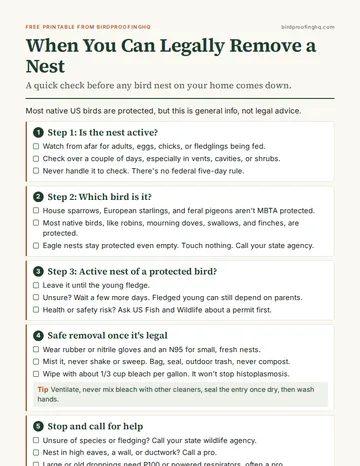
Free printable PDF
When You Can Legally Remove a Nest
A one-sheet check for active versus empty nests, which birds are protected, and what to do while you wait.
Free. We email it to you right away.