Bird Slope: The Anti-Perch Product for Ledges
Contents[hide]
Bird slope is the best anti-perch choice for a straight ledge where you want a solid, low-profile barrier. Its rigid angled face replaces the flat landing surface, so birds cannot settle there. Buy a UV-stabilized system sized for the ledge, then close every seam and end. It is less suitable for rails, open roofs, or irregular surfaces.
In this article, you'll learn whether bird slope fits your ledges and how to install it. We'll cover site fit, gap-free installation, and maintenance checks.
What Is Bird Slope?
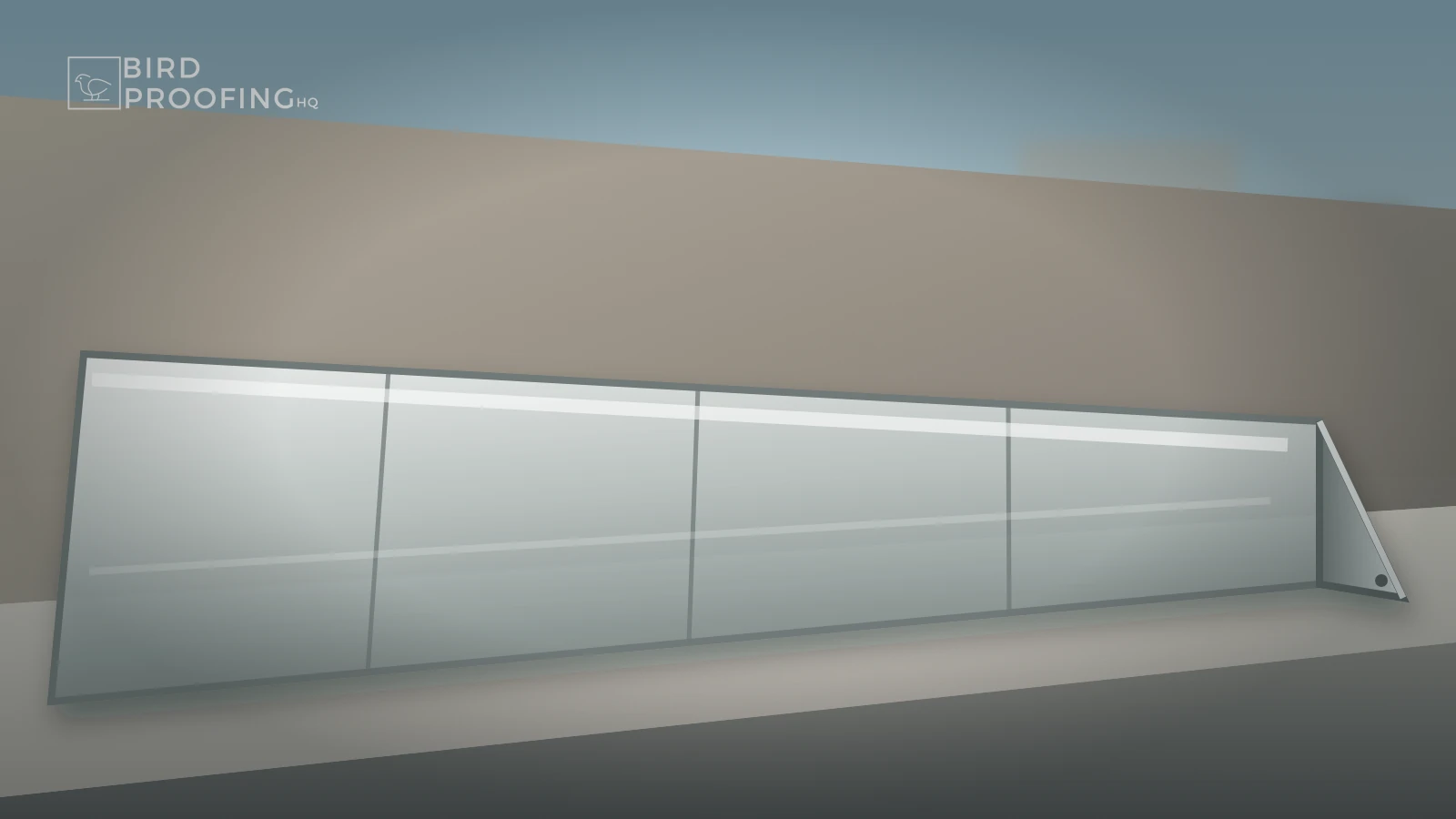
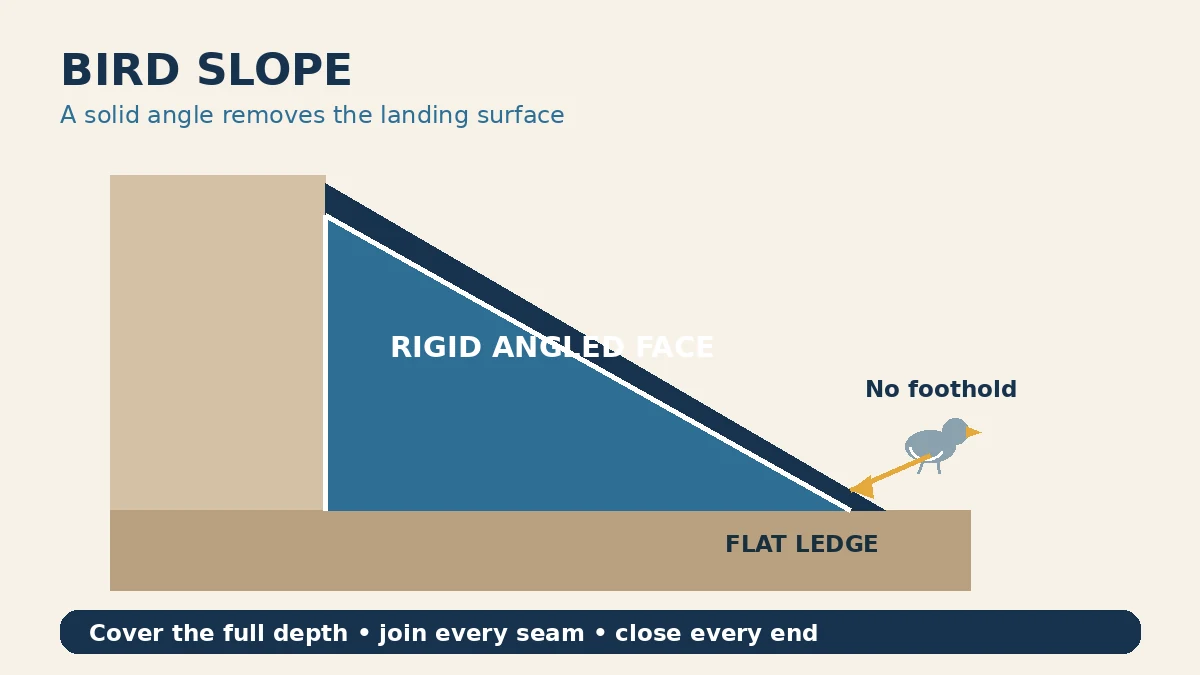
Bird slope is a rigid ledge cover that turns a flat 90-degree corner into an incline. The base sits on the ledge and the upper edge meets the wall. That leaves no level shelf for a bird to land, stand, or build on.
“Bird slope” is also used as a product name. The same device may be called a ledge angle or ledge barrier. Bird B Gone calls its version Bird Slope. Other product names include BirdSlide and AviAngle. Their dimensions and connectors differ, so parts from one system may not fit another.
This is physical exclusion on one defined surface. It does not scare birds, make noise, or require them to learn that the site is unpleasant. The USDA APHIS overview of exclusion describes barriers as long-term wildlife damage tools when access to a resource can be blocked.
Where Bird Slope Works
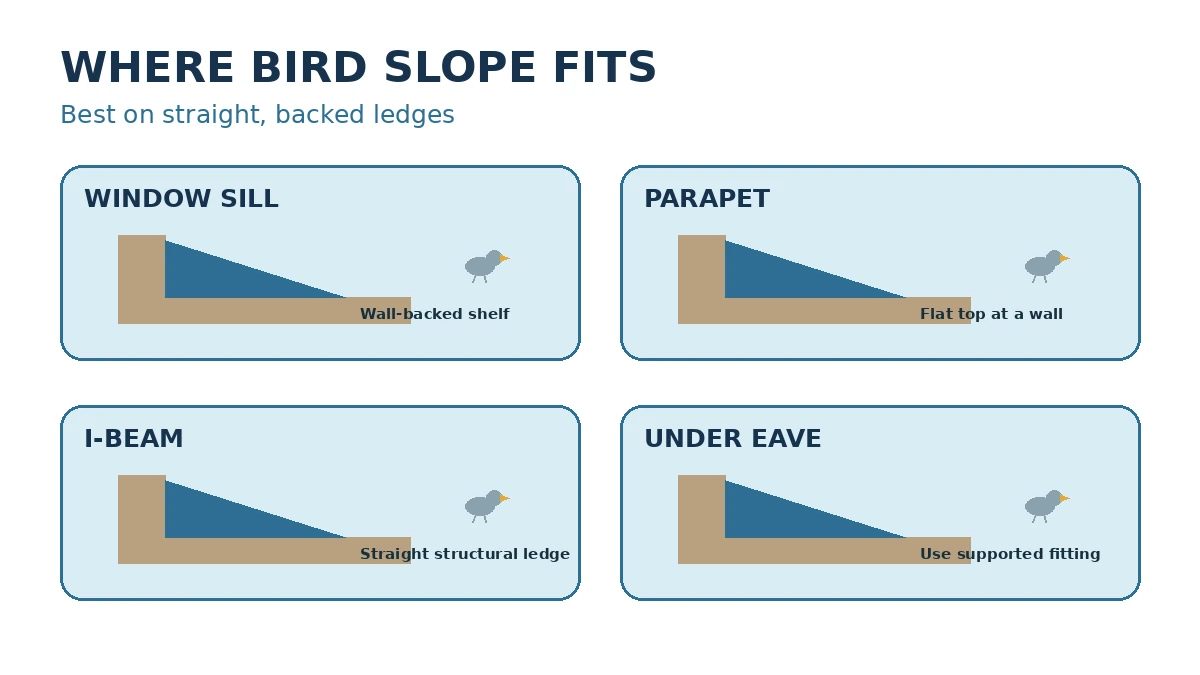
The ideal site has a wall or vertical face at the back and a straight shelf in front. Window sills, parapets, I-beams, signs, parking-garage girders, and the top of a wall can all fit that pattern.
A slope can also close the pocket under an eave when the product is built and mounted for that use. Follow the maker’s detail for overhead work. A ledge product glued upside down without support may peel away and create a trap.
It is a strong choice under light or heavy bird pressure because the finished barrier is solid. Pigeons cannot force through it, and a smaller bird cannot balance between widely spaced tines. The result depends on complete coverage rather than the bird’s size.
Where It Does Not Fit
A handrail still has to work as a handrail, so a solid angled cover is usually the wrong shape. Bird wire is a more discreet option for rails and narrow edges. Pipes, ornate stonework, curved signs, and ledges with many brackets can also be hard to close neatly.
Slope does not protect an open roof, courtyard, garden, or loading bay. Those jobs need a barrier around the whole space, which is the intent of bird netting. It also will not remove food, water, or an indoor roost elsewhere on the property.
Bird Slope vs. Spikes, Wire, and Netting
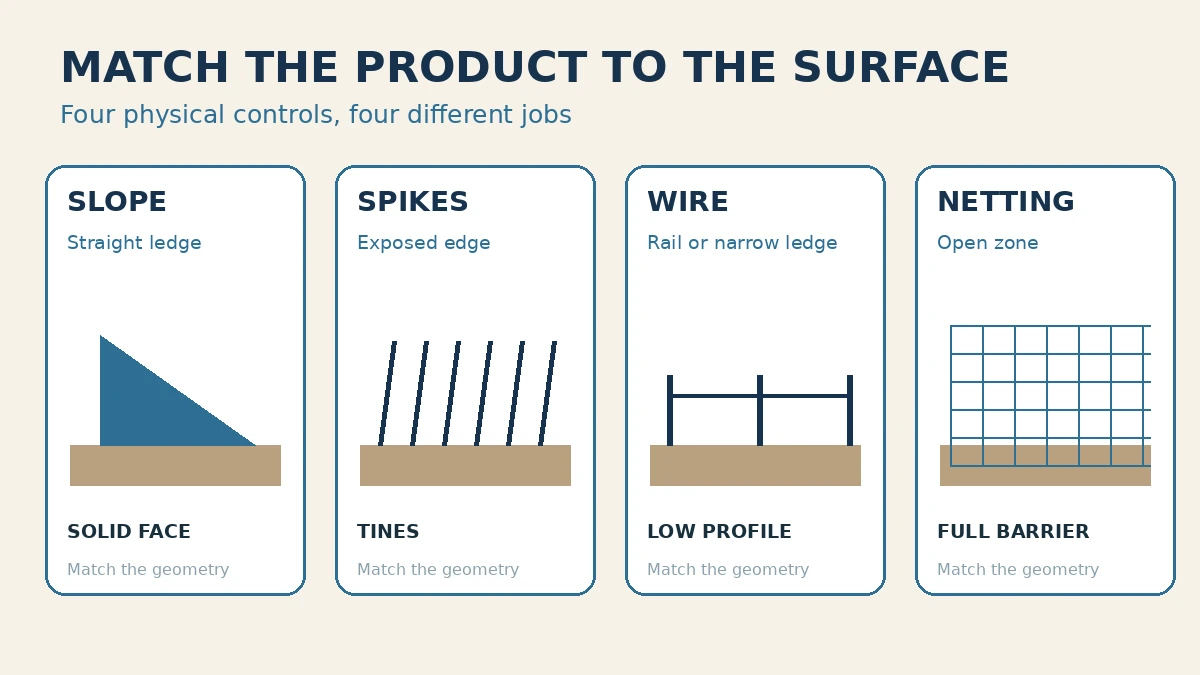
All four products are physical bird deterrents, but each owns a different job.
- Bird slope fits a straight ledge with a back wall. Its solid face can block large and small birds, but it is awkward on curves.
- Bird spikes fit exposed ledges, beams, and roof edges. They come in flexible widths, but they stay visible and need full coverage.
- Bird wire fits rails and narrow ledges. It has little visual impact, but careful spacing and tension matter.
- Bird netting fits openings and enclosed zones. It blocks a whole space, but needs a taut frame and sealed edge.
Choose slope over bird spikes when you can hide a straight run against the architecture and want a closed face. Spikes are easier to fit around pipes, curves, and changing ledge depths. They are also easier to remove for access.
Slope has another practical advantage: leaves and twigs are less likely to collect inside a smooth angled face than among spike tines. The tradeoff is inspection. A closed cover can hide a loose joint, water path, or old nest unless the installer clears the ledge first.
What to Check Before You Buy
Measure the ledge depth from the wall to the front edge at several points. Old masonry and precast concrete are rarely even for a full run. Record the deepest point, every corner, and anything that crosses the proposed slope.
Manufacturers publish different base sizes. Bird B Gone says its standard four-foot section covers a ledge up to 5.5 inches. It offers an extender for wider ledges. Bird Barrier describes BirdSlide for ledges from three to six inches before extensions.
Bird-X lists AviAngle for ledges from six to twelve inches, depending on the module. These figures apply only to those systems. They are not a universal size chart.
Check these parts before ordering:
- UV-stabilized material. Outdoor PVC or polycarbonate should be rated for sun and weather.
- Matching connectors. A joiner keeps neighboring sections aligned and covers the seam.
- End caps. Open triangular ends create a sheltered pocket, which is the opposite of the goal.
- Extenders and supports. Use the maker’s parts for wide ledges and overhead installations.
- Approved fastener or adhesive. The right bond depends on concrete, metal, wood, paint, and expected movement.
- Color and paint guidance. Gray, stone, or a compatible painted finish can blend into the facade.
Compare full-system cost, not the base strip alone. A low base price is not useful if the job also needs many caps, extenders, clips, and tubes of adhesive. For a mixed property, the best bird repellent is often a plan using different physical products on different surfaces.
How to Install Bird Slope Without Leaving Gaps
Start by watching the ledge from the birds’ approach. Confirm they land on the shelf you plan to cover and have not already nested behind a sign, flashing, or trim panel.
1. Check for Birds and Active Nests
Remove no nest until you know its status and species. The U.S. Fish and Wildlife Service says it is illegal under the Migratory Bird Treaty Act to destroy a protected nest with eggs, chicks, or dependent young. If a nest is active or identification is uncertain, pause and follow the bird nest removal rules before closing the ledge.
2. Clean and Dry the Bonding Surface
Wear suitable protective gear around droppings. Remove nests, loose paint, dust, grease, and old sealant. Adhesive stuck to dirt is only attached to dirt. Let the ledge dry fully, then test the chosen adhesive on a small area if the finish is delicate.
3. Dry-Fit the Whole Run
Lay out the sections before applying adhesive. Trim only along the maker’s marked area, and keep the angled face high enough to remove every flat strip. Plan corners, wall returns, downspouts, and expansion joints now.
4. Bond and Join Each Section
Apply the specified outdoor adhesive in the molded trough or pattern. Press the section into place, then add its connector before placing the next piece. Follow the adhesive’s cure time and temperature limits rather than guessing from touch.
5. Close Ends and Inspect From a Bird’s View
Fit end caps anywhere a bird could reach the open profile. Look along the front edge, seams, top contact, and corners. If you can see a level foothold or a pocket behind the system, the run is not finished.
The Installation Mistakes That Cause Failure
Partial coverage moves birds a few feet rather than solving the problem. Cover the full ledge, including short returns and the space behind pipes.
Open ends are another common miss. The triangular cavity inside a slope section is sheltered and attractive if a bird can enter it. End caps are functional parts, not cosmetic extras.
A seam that opens on uneven masonry can become a foothold. Use the system’s joiners, and inspect the run after the adhesive cures. Buildings move and products expand with temperature, so follow the manufacturer detail instead of sealing every joint with a random hard filler.
Finally, do not trap birds or hide an active nest. A barrier should prevent future access after the space is clear. It should never seal an animal inside.
Maintenance and Final Buying Verdict
Inspect the run after severe weather and at least twice a year. Look for lifted bases, loose connectors, cracked plastic, open caps, and debris wedged along the top. Repair a small opening before birds turn it into a regular landing point.
Bird slope is worth buying for a straight, backed ledge where a solid and tidy barrier suits the building. Choose a complete UV-stabilized system with connectors and caps, not loose angle plastic assembled from unrelated parts. For curved surfaces, rails, or whole open spaces, pick the product designed for that geometry instead.
Free: The 5-Step Bird-Proofing Checklist
Work through the right steps in the right order, before spending money on the wrong deterrents. Printable PDF, straight to your inbox.
No spam. Unsubscribe any time.