Bird Deterrent Sound Frequencies: What the Evidence Supports
Contents[hide]
- 1. Why There Is No Magic Frequency
- 2. What Birds Can Actually Hear
- 3. Ultrasonic Devices: The Evidence Says No
- 4. Audible Alarm and Distress Calls: The Category With Real Support
- 5. Predator Calls Work on the Same Principle
- 6. One Frequency, Different Species: The Black-Necked Crane Study
- 7. Why Every Sound Deterrent Fades: Habituation
- 8. Broadband Noise Is a Different Idea Than “The Right Pitch”
- 9. Legal, Welfare, and Neighbor Limits on Sound Deterrents
- 10. When to Stop Trying Sound and Install a Barrier Instead
- 11. Frequently Asked Questions
- 11.1. Does sound actually keep birds away?
- 11.2. What frequency of sound scares birds?
- 11.3. Do ultrasonic bird repellers really not work?
- 11.4. Why do bird sound deterrents stop working after a while?
- 11.5. Is it legal to use a sound deterrent on birds?
- 11.6. Should I use sound or a physical barrier for a bird problem?
Quick Answer
No single sound frequency deters birds reliably. Audible, species-appropriate distress, alarm, and predator calls can work temporarily because the calls signal danger. Ultrasonic devices above 20 kHz do not work because birds cannot hear frequencies that high.
In this article, you'll learn which sound frequencies have real evidence and which are marketing myths. We'll cover hearing range limits, habituation and timing, and when to skip sound entirely.
Why There Is No Magic Frequency
Search around and you will find confident claims that some exact pitch, usually somewhere in the ultrasonic range, clears birds out on contact. That claim does not hold up. Different bird species hear different ranges, respond to different kinds of sounds for different reasons, and stop responding once they learn a sound is not backed by real danger. A number that works on one species in one study is not a setting you can dial in and expect to repel every bird on your property.
That does not mean sound is useless. It means the question is not “what frequency,” it is “what kind of sound, for what purpose, for how long.” The rest of this article works through what the actual research supports for each category, and where the marketing outruns the evidence.
What Birds Can Actually Hear
Most birds hear in a narrower range than people do. A 2004 review of avian hearing research prepared for the USDA’s National Wildlife Research Center found that bird hearing generally spans roughly 300 Hz to 8 kHz, with the sharpest sensitivity concentrated around 1 to 4 kHz, and that no bird species tested has shown sensitivity to ultrasonic frequencies above about 20 kHz. A separate 2016 USDA-APHIS technical note for wildlife biologists puts working bird hearing closer to 1,000 to 3,000 Hertz for practical dispersal purposes, narrower still, and draws the same conclusion from a different angle: “since this range does not include the ultrasonic range, ultrasonic devices will not scare birds.”
Those two numbers do not perfectly match, and that mismatch is itself useful information. Hearing range research is not one tidy fact, it is a body of overlapping findings that agree on the part that matters most to a homeowner: bird hearing tops out well below ultrasound, and it varies by species.
Ultrasonic Devices: The Evidence Says No
This is the most confidently marketed category and the one with the least support. Ultrasonic bird repellers claim to work using sound above roughly 20 kHz, pitched deliberately out of human hearing range. The problem is straightforward: that range is also out of bird hearing range. A 1990 review of device tests published in the Wildlife Society Bulletin examined sonic and ultrasonic device tests across multiple studies and concluded there was no scientific evidence that ultrasound provides effective bird control. The same USDA-APHIS technical note cited above states the same conclusion just as plainly: “Devices that produce ultrasonic sounds are not effective because birds do not hear within the ultrasonic range.”
Regulators noticed the same gap between claims and evidence. In 2001, the Federal Trade Commission sent warning letters to more than 60 manufacturers and retailers of ultrasonic pest-control devices, telling them that effectiveness claims about those products had to be backed by real evidence. A 2025 field study at an industrial site that tested several deterrent methods side by side found the ultrasonic device tested was associated with a higher bird count than the untreated baseline. Birds did not avoid it.
If a product’s marketing leans on the word “ultrasonic” as the reason it works, treat that as a reason to be skeptical, not a selling point. For the full breakdown of ultrasonic products, including why they can bother pets even though they do nothing to birds, see do ultrasonic bird repellers work.
Audible Alarm and Distress Calls: The Category With Real Support
The sound category with genuine evidence behind it is the opposite of ultrasonic: real, audible bird sounds that birds are built to react to. An alarm call is what a bird makes when it spots a predator nearby. A distress call is what an injured or captured bird makes. Both tend to be species-specific, and according to the USDA’s wildlife dispersal guidance, birds may scatter when they hear them because the calls signal genuine danger, not because of the pitch itself. Whether a given bird reacts depends on the season, how recently a real predator has been nearby, how far it is from cover, and what the rest of its flock is doing.
A controlled study in California vineyards tested this directly. Broadcasting recorded distress calls from house finches, American robins, and European starlings, alongside conventional bird control, cut crop damage to about 5.7%, compared with about 13.0% for conventional methods alone. Netting alone did better still, at about 2.3% damage, which is a preview of a point this article returns to later: sound helped, but a physical barrier beat it.
The same USDA guidance is direct about the limits of this category too. Birds habituate to alarm and distress calls that are never followed by a real threat, and generic recorded sounds like gunshots or car horns work briefly at best unless paired with something that actually causes discomfort. As the guidance puts it: “No single technique or tool will deter birds in every instance or situation; there is no silver bullet.” For a species-by-species rundown of which calls to use where, see which bird deterrent sounds actually work.
Predator Calls Work on the Same Principle
Predator calls, a hawk’s screech or an owl’s call, work for the same underlying reason as distress calls: they signal a real threat the bird is built to take seriously, not a specific pitch. A hawk call means something to a songbird because hawks actually hunt songbirds, not because it happens to land in some ideal frequency band. That is also why predator calls are species-selective. A call that clears a feeder of sparrows will not do much to a flock of city pigeons that rarely encounters that predator and has learned to tune out most noise.
Pairing a predator call with a visual cue, a decoy owl or hawk silhouette, reinforces the same message through two senses at once, though both fade with repetition for the same habituation reasons covered below.
One Frequency, Different Species: The Black-Necked Crane Study
If you want a clear example of why “the right frequency” is the wrong question, look at a 2025 field study on black-necked cranes, a protected, vulnerable species studied at wintering sites in China. Researchers tested tones at 200 Hz, 6,400 Hz, and 12,800 Hz, played as steady tones, alternating tones, sweeps, and stepped patterns.
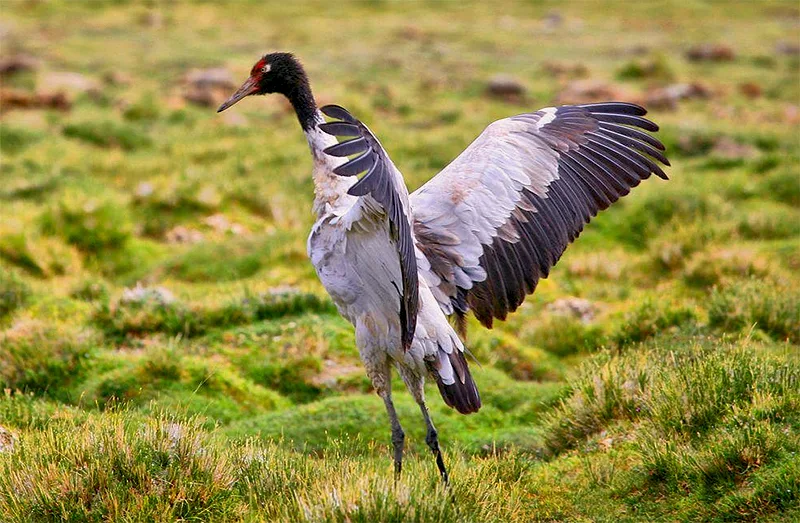
The strongest escape response came from the higher tone, 12,800 Hz, combined with more variable patterns rather than a steady drone. That is still well within audible range for a large bird and nowhere near ultrasonic. But the effect did not last. Cranes often returned to the area within about 20 minutes of the sound stopping. That result is a useful two-part lesson: a specific frequency can outperform others for a specific species in a specific study, and even the best-performing sound in that study only bought about 20 minutes of relief. Neither part of that finding scales into “here is the number to use in your yard.” It scales into “sound is a short-term push, not a fix,” which is the theme running through every category in this article.
Why Every Sound Deterrent Fades: Habituation
Habituation is the reason every sound-based method eventually stops working, and it is not a flaw specific to any one product. A bird hears a sound, treats it as a possible threat, and waits to see what happens. If nothing happens, again and again, the bird learns the sound is safe to ignore. USDA guidance describes this happening within days to a couple of weeks for most auditory scare tactics, faster the more predictable the sound is.
A few things measurably slow it down: varying the sound instead of looping the same recording, moving the speaker or device to a new spot every few days, triggering it only when birds are actually present instead of on a timer, and pairing it with something that represents a real consequence, like an actual barrier or a genuine predator presence. None of these tricks eliminate habituation. They buy time. A small collision-avoidance study using zebra finches found a trend, not a statistically significant result, toward a 4 to 6 kHz frequency-modulated signal producing the strongest avoidance response among the sounds tested, which fits the broader pattern here: frequency tweaks can shift results a little, but nothing in the evidence turns a temporary scare into a permanent one.
Broadband Noise Is a Different Idea Than “The Right Pitch”
Not every acoustic approach is built around finding one scary sound. A different strategy, sometimes called a sonic net, broadcasts broadband noise, sound spread across a wide range of frequencies at once, tuned to overlap the frequencies birds use for their own alarm and contact calls. The idea is not to frighten the bird with a threatening noise. It is to make it harder for the bird to hear its flock’s warning calls or an approaching predator, so the area feels less safe to occupy even without any single alarming sound. Field testing of this approach at an airfield found it reduced bird numbers in the treated area.
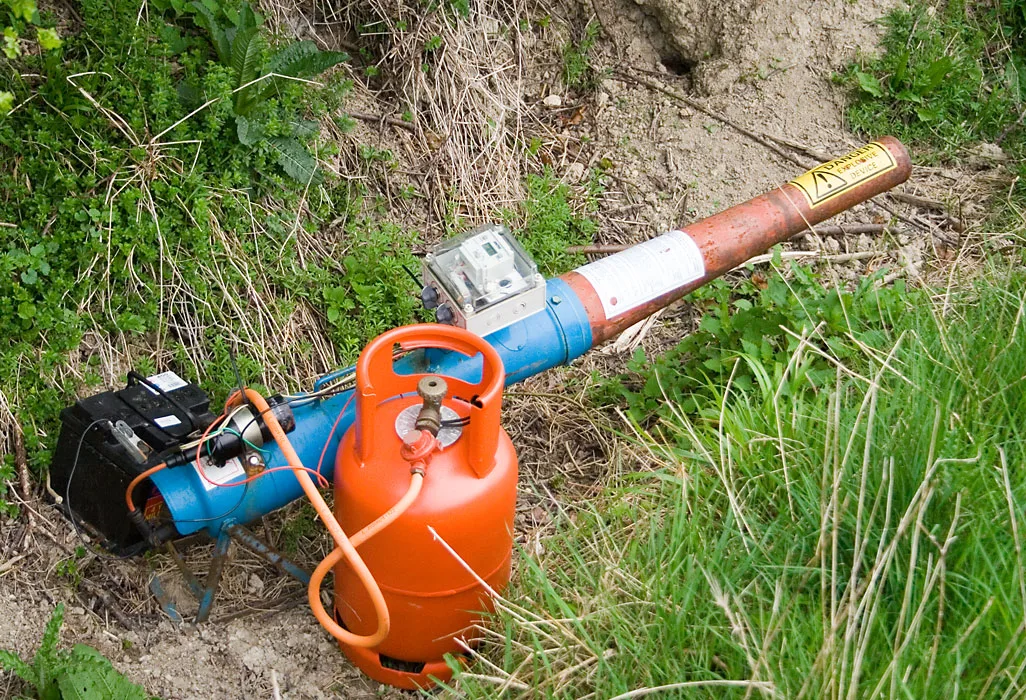
The propane gas gun pictured at the top of this article works on a cruder version of the same broadband-noise idea: a single loud blast rather than continuous noise, aimed at producing a startle response rather than a specific threat signal. USDA guidance notes that gas cannons are effective in some situations but that habituation is common, especially when they fire on a fixed timer instead of only when birds are actually present. It is also worth knowing before you buy one: local and national rules can restrict the purchase, storage, or use of pyrotechnic and cannon-style devices, and local noise ordinances can apply as well. Check your local rules before installing one, not after your neighbor calls to complain.
Legal, Welfare, and Neighbor Limits on Sound Deterrents
You generally do not need a federal permit to haze or scare wild birds. The U.S. Fish and Wildlife Service’s migratory bird depredation permit guidance states that hazing and scaring do not require a federal depredation permit, with eagles and species listed as federally threatened or endangered as the exceptions.
That permission has a hard limit. It covers scaring birds away from an area, not disturbing an active nest. Under the Migratory Bird Treaty Act, a nest with eggs or dependent young from a protected species cannot legally be disturbed without a federal permit, and using a loud sound deliberately aimed at an active nest crosses that line. House sparrows, European starlings, and rock pigeons are excluded from that federal protection, but confirm the species before assuming a nest is fair game. For the complete rules on which species are covered and which are not, see are birds protected by law.
Beyond legality, there is a welfare and courtesy dimension that gets less attention than it should. A sound loud enough to reliably startle a bird is also loud enough to bother the people and pets around it, and running it constantly is not more effective, since habituation sets in regardless. Trigger devices on motion rather than a timer, keep volume proportional to the actual area you are protecting, and avoid running audible deterrents at night when birds are already roosting and the noise only affects your neighbors.
When to Stop Trying Sound and Install a Barrier Instead
Every category covered here shares the same ceiling: sound moves birds, it does not block them. A USDA-APHIS risk assessment of exclusion methods describes netting, wire mesh, and anti-perching devices as standard tools precisely because they physically block access instead of trying to convince a bird a threat exists, which means they do not have a habituation problem at all. The tradeoff is upfront cost and proper installation and maintenance, not an ongoing arms race against a bird’s memory.
Reach for a barrier once a sound deterrent has already worked once or twice and stopped, once the birds involved are bold, city-adapted species that shrug off most noise, or once the value of what you are protecting, a crop, a ledge, a vent, justifies a one-time fix over a recurring one. Bird netting seals off gardens, porches, and roosts outright. Bird spikes close off ledges and rooflines the same way. Neither needs to be varied, moved, or rotated to keep working, which is the one thing no sound-based method in this article can claim. For the full range of barrier and scare options side by side, see the bird deterrents overview.
Frequently Asked Questions
Does sound actually keep birds away?
Some sound does, temporarily. Audible alarm calls, distress calls, predator calls, and loud broadband noise can move birds out of an area for days to a few weeks. No sound-based method has evidence of a permanent fix, because birds either learn the sound is not a real threat or simply return once it stops.
What frequency of sound scares birds?
There is no single frequency that works on every bird. The evidence supports audible, species-appropriate alarm calls, distress calls, and predator calls, but the meaning and context of the sound matter more than a universal pitch. One 2025 study on a protected crane species found a higher audible tone combined with varied patterns worked best for that species specifically, not as a general setting for other birds.
Do ultrasonic bird repellers really not work?
Correct, they do not. Ultrasonic means above roughly 20 kHz, and no bird species tested has shown the ability to hear sound that high. A 1990 scientific review found no evidence ultrasound controls bird damage, and in 2001 the FTC warned more than 60 manufacturers and retailers of ultrasonic pest devices that their effectiveness claims needed scientific proof.
Why do bird sound deterrents stop working after a while?
Habituation. A bird that hears the same sound repeatedly without anything bad actually happening learns to ignore it, often within days to a couple of weeks. Sounds last longer when you vary them, move the speaker, trigger it only when birds are present, and pair it with a real deterrent like a barrier or an actual predator.
Is it legal to use a sound deterrent on birds?
Generally yes. You do not need a federal permit to haze or scare most wild birds, with eagles and federally listed threatened or endangered species as the main exceptions. You still cannot use any method, sound included, to disturb an active nest with eggs or dependent young of a protected species, and local noise rules can limit loud devices like propane cannons.
Should I use sound or a physical barrier for a bird problem?
Use sound for a short-term push, such as clearing a roost before it becomes established, and use a physical barrier for anything you want solved for good. Netting and spikes block access outright, so they do not fade the way sound does once a bird learns the noise is not a real threat.
Images: Gas gun bird scarer by Andrew Dunn, CC BY-SA 2.0, via Wikimedia Commons. Black-necked Crane (Grus nigricollis) by Candle Tree, CC BY-SA 4.0, via Wikimedia Commons. Images were converted to WebP.


Free: The 5-Step Bird-Proofing Checklist
Work through the right steps in the right order, before spending money on the wrong deterrents. Printable PDF, straight to your inbox.
No spam. Unsubscribe any time.